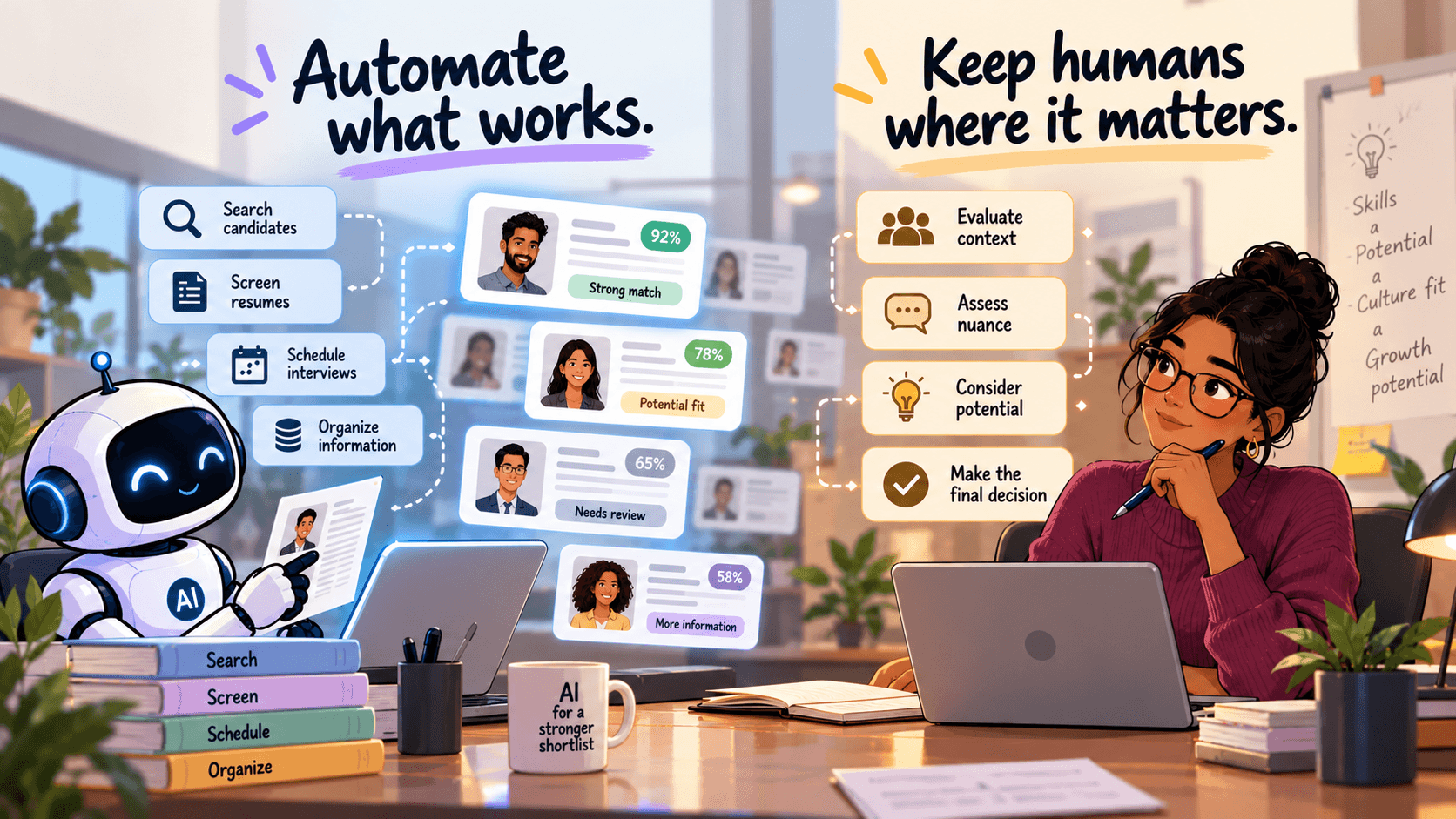
When teams evaluate AI candidate screening, the question often starts too broadly: should AI screen candidates or should people? That framing hides the real design work. Screening is not one task. It is a sequence of activities that range from organizing information to interpreting evidence and making consequential decisions.
Some activities are structured and repeatable. Others depend on context, incomplete information, or judgment about what the role actually requires. A good workflow separates these tasks and defines the right level of automation for each one.
The goal is not to keep every activity manual or to automate every possible step. It is to reduce unnecessary coordination, make relevant information easier to review, and preserve human responsibility where a decision affects a candidate’s opportunity to progress or be hired.
This article offers a practical framework for deciding what AI can organize, what it may recommend for review, what needs a human checkpoint, and what should remain a human decision.
Start by breaking screening into individual tasks
Before choosing automation, map the work that happens between receiving a candidate profile and deciding what to do next. A typical workflow may include:
1. Collecting and organizing candidate-submitted information.
2. Comparing available information with role criteria that the team has already approved.
3. Summarizing relevant experience and identifying evidence that may support a match.
4. Flagging missing, inconsistent, or ambiguous information.
5. Coordinating follow-up questions or scheduling the next step.
6. Recommending a review queue or possible next action.
7. Deciding whether a candidate progresses, is set aside, or is selected for hire.
These tasks do not have the same risk profile. Organizing information usually has a different impact from using a model output to exclude someone from consideration. That is why an automation boundary should be defined at the task level, not by labeling an entire workflow “automated” or “human-led.”
A practical boundary framework
The distinction is not simply between tasks AI can perform and tasks that people must perform. It depends on the nature of the task, the quality of the available evidence, and the consequences of getting the decision wrong.
A useful way to establish these boundaries is to examine each stage of candidate screening separately.
1. Define the criteria before screening begins
AI can help organize role requirements into a screening framework, but the hiring team should first agree on what the role actually requires.
The hiring manager should confirm which skills and qualifications are essential, which are preferred, and what evidence would demonstrate that a candidate meets the requirements.
The boundary: AI can help apply the criteria, but the hiring team must define and approve them.
2. Automate information gathering and organization
Candidate search, profile summarization, scheduling, and the organization of candidate information can involve repetitive work. AI can help make this information easier to review and manage.
However, a relevant keyword or a well-written profile does not automatically indicate that someone is suitable for the role. Search results and summaries should be treated as inputs to evaluation, not as proof of capability.
The boundary: Automate routine information handling without treating the output as a final assessment.
3. Use human review when evidence needs interpretation
AI can organize candidate responses and highlight potential matches against agreed criteria. Human reviewers should examine the underlying evidence when an answer is ambiguous, experience is transferable, or the candidate's capabilities require further exploration.
For example, a candidate may not have used the exact technology listed in a job description but may have relevant experience with a comparable system. A rigid screening rule could overlook that distinction.
The boundary: When context or judgment changes how evidence should be interpreted, human review becomes important.
4. Establish clear escalation points
Not every screening decision will be straightforward. A candidate's information may be incomplete, conflicting, or insufficient to support a reliable assessment. The screening process should define what happens in these situations.
Rather than automatically rejecting the candidate or proceeding without further checks, the workflow should flag the uncertainty and route the case for appropriate review.
The boundary: When the available information does not support a confident next step, the system should pause or escalate instead of assuming an answer.
5. Keep consequential decisions accountable
AI can help organize candidate comparisons, summarize assessment findings, and present information relevant to the hiring decision. The hiring manager must still evaluate the available evidence and remain accountable for the final hiring decision.
The same principle applies to progression and rejection. Teams should be able to review the reasons behind consequential outcomes rather than relying on an unexplained automated result.
The boundary: AI can inform the decision, but responsibility for the hiring decision remains with the hiring team.
6. Review the boundaries as the process evolves
Automation boundaries should not be treated as permanent simply because they were defined at implementation. Teams should review cases that required escalation, instances where information was insufficient, and decisions that needed to be reconsidered.
This helps identify where the workflow needs clearer criteria, better information, or stronger human checkpoints. Any changes should be evaluated against the role requirements and the organization's hiring standards.
The goal is not to automate as much of the screening process as possible. It is to automate appropriate work while preserving the judgment, transparency, and accountability that sound hiring decisions require.
A useful principle is simple: automate the work that supports a decision without automating away accountability for that decision.
What AI can help with in candidate screening
Organizing information into a consistent format
Candidate information often arrives in different formats and levels of detail. AI-supported tools may help organize submitted information into a consistent view, identify duplicate records, and bring key details together for review. This can reduce the amount of manual navigation required before a recruiter begins evaluation.
The source should remain accessible. A clean summary must not erase where a detail came from, convert an unverified statement into a verified fact, or silently fill in information the candidate did not provide. Missing data should remain missing, not become a negative assumption. This is closely related to the problem ofcandidate context getting lost across the hiring process.
Summarizing evidence against agreed criteria
Once the team has defined the role criteria, AI may help summarize information relevant to those criteria. For example, it can surface examples of project ownership from a candidate’s submitted experience or flag that a particular required qualification is not documented in the available material.
The distinction between “not documented” and “does not have” matters. A profile may omit a skill because the resume is brief, the candidate uses different terminology, or the relevant work happened under a different title. A screening summary should show what the available evidence says and what remains uncertain.
Flagging gaps and inconsistencies
AI may help detect that dates appear inconsistent, a required field is blank, or a claim needs clarification. The proper next step is not always rejection. In many cases, the signal should prompt a question or a human review. The workflow should distinguish between an objective requirement that is not met and information that is simply incomplete.
Supporting coordination
Scheduling, reminders, routing a completed review to the next owner, and maintaining an activity record may be appropriate automation candidates when the rules are clear. The system should still respect candidate preferences, approved communication practices, and stop conditions when the process needs human attention. These coordination tasks are one part of amore connected hiring workflow.
What should remain under human judgment
Interpreting ambiguous or nontraditional experience
A candidate’s capabilities may not be expressed in the exact language used in a job description. Career changes, equivalent experience, different educational paths, unfamiliar job titles, career breaks, and work completed in smaller organizations may require interpretation. A system can help surface related information, but a person should be able to examine whether the evidence demonstrates the capability the role needs.
This does not mean every nontraditional profile should advance. It means the reason for a decision should be tied to role-relevant evidence rather than an assumption that a familiar career path is the only valid one.
Resolving incomplete, conflicting, or low-confidence evidence
When the available information does not support a reliable conclusion, the workflow should not hide that uncertainty. It can request additional information, send the case for review, or pause the process. If different sources conflict, a reviewer needs to see the conflict rather than receive a single flattened summary.
A useful rule is to distinguish “insufficient information” from “evidence that the requirement is not met.” They are different conditions and may require different next steps.
Making consequential progression and hiring decisions
AI-supported screening may help prioritize information and prepare recommendations. It should not silently become the accountable decision-maker through a chain of automatic filters that no one understands. Teams need to define which actions require human review and who is responsible for the final choice.
The hiring manager remains responsible for the final hire decision. A candidate progressing through the workflow is not the same as a hiring decision, and a candidate being set aside should not become an unexplained entry in a system log.
Handling exceptions and candidate requests
Some situations should route directly to a person because they are outside the normal flow. These may include accommodation requests, a question about how candidate information is being used, a request to correct a record, a concern about the process, or an issue the system cannot confidently resolve. The exact routing policy should be agreed with the organization’s responsible teams.
Do not make a workflow depend on an AI agent improvising a response whenever a candidate raises an unexpected issue. Define which situations can be answered safely, which require more information, and which should be handed to a person.
Use this task-by-task screening checklist
For each proposed automation, complete the following review before putting it into the live workflow:
1. Purpose: What specific task is being automated, and what problem does the automation solve?
2. Input quality: Which data sources does the task use? Can the information be missing, stale, contradictory, or incorrectly extracted?
3. Role relevance: Is the task tied to criteria the hiring team has agreed are relevant for this role?
4. Impact of error: What happens if the system is wrong? Could a candidate be excluded, delayed, misrepresented, or contacted inappropriately?
5. Review boundary: Does the task organize, assist, recommend, decide, or escalate? What level of human review is needed?
6. Explainability: Can the reviewer see the evidence that informed the output and distinguish facts from inferences?
7. Override: Can a responsible person correct the information, challenge the recommendation, or change the next step?
8. Record: What will be retained about the input, output, review, and final action, consistent with the organization’s policies?
9. Monitoring: How will the team identify recurring errors, uneven outcomes, inappropriate recommendations, or unexpected behavior?
10. Ownership: Who is responsible for investigating problems and updating the workflow?
This checklist should produce a concrete workflow decision. It should not turn into a general statement that every AI feature is safe as long as a human exists somewhere in the process.
An illustrative example of a screening workflow
Consider a fictional company hiring a senior backend engineer. The hiring team has agreed that the role requires experience designing and operating production systems, making trade-offs under constraints, and collaborating with product and infrastructure colleagues. This is an illustrative example, not a Talentz customer story.
The screening workflow organizes submitted profiles and summarizes the evidence that appears relevant to those criteria. One profile includes a title that does not match the company’s preferred terminology but describes ownership of a production service. The system flags the relevant experience and notes that scale and responsibility still need validation.
That is a useful assist. The recruiter can review the source information and decide whether the profile merits further consideration. If the candidate progresses, the interview should test the unresolved questions. If the candidate is set aside, the team should retain the actual reason rather than record only a vague label such as “low match.”
Now consider a different profile where the information is incomplete. The workflow should make that gap visible. Depending on the approved criteria and process, the team may request clarification or decide that the evidence available is insufficient. It should not silently treat missing information as proof that the candidate lacks the capability.
The lesson is not that AI must always advance a candidate when evidence is ambiguous. It is that the workflow should make uncertainty visible, apply agreed criteria, and preserve human accountability for consequential decisions.
Keep the screening record useful
A candidate record should help the team understand what was considered and what happened next. The record does not have to be a long narrative for every profile, but it should be specific enough to support review and correction.
Depending on the organization’s policies and data retention requirements, useful record elements may include the criteria applied, the evidence surfaced, what was missing or uncertain, the recommendation or next action, the identity or role of the reviewer, the final outcome, and the reason recorded for progression or rejection. The organization should define what must be retained and for how long before launching the workflow.
Records also make it possible to review the process as a whole. Teams can look for patterns such as repeated corrections to summaries, recurring confusion about a criterion, or a high volume of cases that are escalated because the role brief is unclear. The purpose is to improve the screening process, not to assume that every difference in outcome is caused by the AI system.
Measure decision quality, not just volume
The number of profiles processed or the time taken to complete a step can be useful operational information, but neither tells the team whether screening is helping it make sound decisions. A balanced review should examine the quality and consequences of the work as well as process efficiency. For a related look at making each technical hiring stage useful, readHow to Improve Technical Hiring Without Adding More Interview Rounds.
· Correction patterns: How often do reviewers fix extracted details or summaries, and what types of errors recur?
· Escalations: Which cases require human intervention, and are the reasons understood and addressed?
· Candidate progression and rejection records: Can the team explain the criteria and evidence behind important outcomes?
· Consistency: Are agreed role criteria being applied consistently, and are changes documented?
· Candidate experience: Are communications clear, timely, appropriate, and respectful of candidate preferences?
· Fairness and compliance review: Does the organization have an appropriate process to monitor outcomes and meet any applicable legal or policy obligations?
No single measure should be interpreted in isolation. For example, fewer escalations could reflect a clearer workflow, but it could also mean the workflow is failing to surface exceptions. Review the underlying cases before deciding that a metric has improved.
Plan for compliance and privacy before launch
AI candidate screening may involve personal information and can affect a person’s opportunity to progress. Before deployment, teams should review the applicable rules and internal policies for candidate notices, accessibility and accommodations, data sources, retention, information security, auditability, and evaluation of potential adverse patterns. Requirements differ by jurisdiction and by how a tool is used, so a general checklist cannot replace local legal and compliance review.
It is also important to tell candidates what information is required, avoid gathering data without a clear purpose, restrict access to authorized people, and establish a procedure for correcting information that is inaccurate. The specific process should reflect the organization’s legal obligations, privacy commitments, and actual tool behavior. For broader Talentz perspectives on AI and hiring, browseTech Vibes.
How Zee fits into a responsible screening workflow
Talentz positions Zee as a connected pre-hire workflow that supports candidate discovery, candidate conversations, and structured interviews. Within that workflow, the team should be able to identify where a person needs to review information, what evidence is being surfaced, and what decision remains with the hiring manager.
The useful product question is not simply whether a tool can screen a large number of profiles. Ask whether it helps your team understand why a candidate is being surfaced, what still needs to be validated, how exceptions are handled, and how the final decision is recorded. Those are the questions that connect automation to a usable hiring process.
Learn more about Talentz and its approach to AI-supported hiring on the About page.
To explore how Zee could fit your process, see the Zee workflow.
Build screening boundaries one task at a time
AI candidate screening is easier to govern when teams stop treating it as one large capability. Break the workflow into tasks, classify each task by what it does, evaluate the impact of an error, and define a clear boundary for human review. Organizing and summarizing information can support a recruiter’s work. Recommendations should expose the evidence behind them. Uncertainty and exceptions need a defined path. Consequential hiring decisions need an accountable owner.
Start with one screening task, test it against ordinary and unusual cases, and review the record it produces. Make the permitted action, human checkpoint, and escalation owner explicit. Expand only when the team understands how the task behaves and how it will be monitored.
A responsible screening workflow is not one that automates the most steps. It is one that automates appropriate work while keeping decisions visible, reviewable, and accountable.
Frequently asked questions
What is AI candidate screening?
AI candidate screening refers to using AI-supported tools to organize candidate information, compare available evidence with role criteria, summarize profiles, identify gaps, or support decisions about next steps. The exact capabilities and risks depend on the tool and how the organization uses it.
Which candidate screening tasks are suitable for automation?
Tasks with clear rules and repeatable inputs, such as organizing information, formatting records, coordinating routine steps, and preparing summaries for review, may be suitable. Teams still need to validate outputs, protect source context, and define how errors and exceptions are handled.
Should AI automatically reject candidates?
Teams should not allow consequential exclusion to happen by default simply because it is technically possible. Before any automated rejection behavior is considered, the organization needs to define the criteria, assess the risks, establish appropriate oversight, and confirm compliance with applicable requirements. The hiring team must retain clear accountability for hiring decisions.
How should AI handle missing candidate information?
The workflow should distinguish between information that is missing and evidence that a requirement is not met. Depending on the role and approved process, the next step may be clarification, human review, or a documented decision that the available information is insufficient.
What should teams monitor after implementing AI candidate screening?
Review errors and corrections, escalation reasons, the consistency of criteria application, the quality of progression and rejection records, candidate experience, and any fairness or compliance indicators required by the organization. Look at underlying cases before interpreting a change as an improvement.