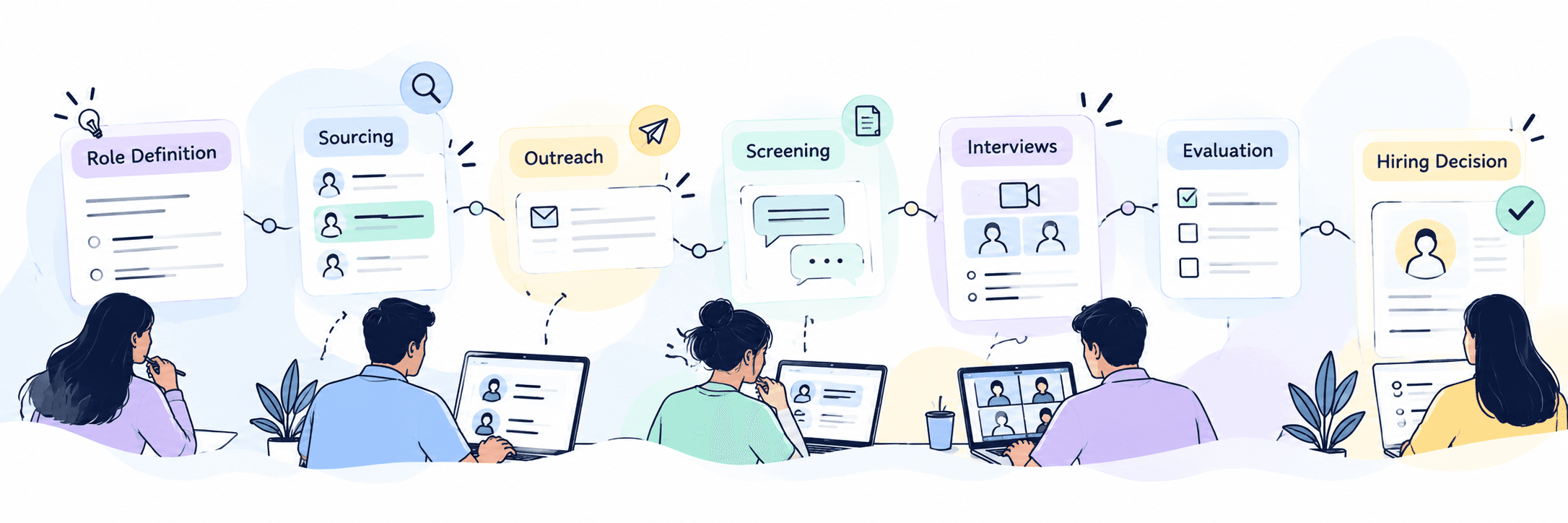
A hiring process can have clear stages and still feel disconnected. Recruiters source candidates in one place, conversations happen in another, screening notes are stored elsewhere, and interview feedback arrives in separate forms. Each activity may be completed, but the work between activities can remain difficult to follow.
Building a connected hiring workflow is not primarily a matter of buying another tool. It begins with understanding the candidate journey, the decisions each stage needs to support, and the information that must move between people and systems.
The practical objective is to reduce avoidable repetition, make relevant context available at the right moment, and help the hiring team make decisions using job-related evidence. This guide lays out a method for mapping, improving, and measuring that workflow without automating judgment away.
For an overview of the approach, explore the Talentz hiring platform.
What Is a Connected Hiring Workflow?
A connected hiring workflow is a recruiting process in which each stage builds on the useful work completed before it. Candidate information, role requirements, conversations, assessments, and next steps are linked in a way that lets the next participant act without unnecessarily reconstructing the past.
Connected does not mean every detail must be stored in one system or shown to every person. Multiple tools can work together if responsibilities, information flows, and sources of truth are clear.
The key is continuity: the next person can access relevant information, understand its source, and see what remains to be done.
A typical pre-hire journey may include:
· Role definition
· Candidate sourcing
· Outreach and engagement
· Screening
· Interviews and assessments
· Evaluation and feedback
· Hiring decision
The exact stages vary by company and role. Design should reflect the actual process rather than impose a generic template.
Start With the Hiring Journey, Not the Tools
Map the real process from role brief to decision
Write down the steps a candidate actually moves through. Include work that happens between formal stages, such as recruiter research, manager calibration, candidate follow-up, scheduling, feedback reminders, and decision meetings.
These informal activities often contain handoffs most likely to depend on memory.
For each stage, document five items:
· Purpose: What decision or action should this stage support?
· Owner: Who is accountable for completing the work?
· Inputs: What information is needed to begin?
· Outputs: What should be true or available when the stage ends?
· Next recipient: Who needs the output, and what will they do with it?
For example, the purpose of a screening conversation is not merely to complete a call. It may be to clarify relevant experience, confirm practical constraints, understand candidate interest, and identify questions for a technical interviewer. The output should make those results available in a useful format.
Separate stages from handoffs
A process map often lists activities but overlooks transitions. A handoff occurs when responsibility, information, or the next action moves from one person or system to another.
Every handoff should answer four questions:
· What is being passed?
· Why does it matter?
· Who owns it?
· How does the recipient know it is complete?
If a hiring manager routinely messages a recruiter to ask why a candidate was shortlisted, that is a useful diagnostic. It does not automatically prove the software is inadequate. It may indicate that the handoff output is undefined or the relevant information is not available at the point of use.
Identify Where Information Changes Hands
Follow one candidate journey through the process. Observe what is created, where it is recorded, and what the next participant can actually see. Do not assume that information is usable simply because it exists in a system.
Sourcing to outreach
The outreach owner needs to understand why the candidate is relevant and what role-specific message is appropriate. The handoff may include the target role, relevant evidence, reason for outreach, and any caveat that should not be overstated. A preliminary match should remain a hypothesis until it has been checked.
Outreach to screening
Candidate replies may clarify interest, availability, priorities, or questions about the role. Record the job-relevant information needed for the next conversation and retain enough source context to interpret it accurately. Avoid copying unnecessary personal details simply because they were shared.
Screening to interview
The interviewer needs the criteria they are expected to assess, what the team has already learned, and the open questions the interview should answer. This prevents the interview from becoming a second screening call unless a second screening is genuinely required.
Interview feedback to decision
Feedback should identify the criterion being assessed, the relevant observation or evidence, and the evaluator’s conclusion. A rating without rationale may be difficult to compare across interviewers. A useful workflow makes it possible to review both the conclusion and its basis.
If your team is already experiencing these handoff issues, our companion article explains where candidate context gets lost across the hiring process.
Define What Context Should Move Forward
The most effective handoff is not the longest one. It contains the minimum useful context needed for the next person to act well. Too little context forces reconstruction. Too much can bury important information and expose details that are not necessary for the task.
A practical handoff template can include:
· Role and stage: Which role is this for, and where is the candidate in the process?
· Relevant evidence: What job-related experience, work sample, or answer has been observed?
· Source: Where did the information come from, and when was it collected?
· Interpretation: Why does it matter for this role? Clearly separate facts from inferences.
· Candidate perspective: What relevant questions, preferences, or constraints has the candidate shared?
· Open items: What remains uncertain or needs validation?
· Next action: What should happen next, who owns it, and by when if a deadline is appropriate?
Adapt the template to the role and stage. A technical interviewer may need evidence related to an engineering requirement. A recruiter handling scheduling may need availability and next-step details. The principle is relevance, not uniform volume.
Reduce Repeated Work Across the Workflow
Identify repetition before automating it
Repeated work is not always waste. A candidate may reasonably be asked to verify a critical detail, and different interviewers may need to examine a capability from different angles. The goal is to remove repetition that does not add useful information.
Review the process for recurring patterns:
· Candidates answering the same basic questions several times
· Recruiters rebuilding the same candidate summary
· Interviewers duplicating assessments
· Managers requesting information that should already be available
For each pattern, ask whether the repetition serves a clear purpose. If it does, make that purpose explicit. If it does not, clarify the handoff, update the process, or change the information flow before adding automation.
Create one reliable place for each important item
Teams do not necessarily need one system for everything, but they do need clarity about where the authoritative version of important information lives. If candidate status is updated in one place and interview feedback is tracked in another, the relationship between them should be clear.
Define ownership for updating records and correcting mistakes. Establish naming conventions and required fields only where they support a real decision or action. Excessive mandatory fields can create administrative burden without improving the quality of the process.
Connect Candidate Conversations to the Workflow
Candidate conversations are not separate from the recruiting process. They can affect whether the team should proceed, what it should clarify, and how it should communicate next.
A candidate’s question about the role may reveal an expectation that needs to be addressed. A change in availability may alter scheduling. A clarification about a project may change what an interviewer needs to investigate.
A connected workflow should preserve relevant conversation outcomes and make the next action clear. It should not treat every message as a permanent record of equal importance. Teams need policies for appropriate collection, access, retention, and use of candidate information.
Where automation supports communication, it should respect the state of the conversation. A follow-up should not ignore a candidate’s recent reply or send a message that contradicts what the team has already communicated. The specific safeguards and behavior depend on the tools used and should be tested before deployment.
Keep Humans Responsible for Hiring Decisions
A connected workflow can support a decision without making the decision. Automation may help organize information, surface relevant notes, prepare summaries, or route tasks. People remain responsible for interpreting evidence, resolving disagreement, and deciding whether a candidate should progress.
Design this boundary into the process. Make clear which actions are administrative, which outputs are recommendations, and which decisions require human review. A reviewer should be able to inspect underlying evidence, challenge a summary, and correct errors rather than merely approve a system-generated conclusion.
The workflow should make uncertainty visible. A candidate may appear to meet a requirement based on a resume, but the team may still need to verify depth of experience. Recording “not yet assessed” is more useful than converting an assumption into a definitive qualification.
This distinction is central to Talentz’s approach to hiring decisions: technology can support the process, while people retain responsibility for hiring decisions.
Measure the Workflow, Not Just Individual Tools
Evaluate a connected workflow by whether it improves the work of the hiring team and the candidate experience. Tool adoption alone is not enough. Choose a small set of measures that correspond to the problems the team is trying to solve, establish a baseline, and review results consistently.
Handoff completeness
Sample a set of handoffs and check whether the next participant received the information required for the next action. Define completeness in advance. A useful handoff is not one with the most fields filled in; it is one that enables the recipient to proceed without avoidable reconstruction.
Repeated questions and duplicated work
Track recurring instances where candidates are asked for information they have already provided or team members redo the same research. Use a clear definition so necessary verification is not incorrectly counted as waste.
Response continuity
Review whether candidate replies and questions are reflected in the next communication or action. This can be assessed through a small quality review rather than assuming a message was handled properly because a status changed.
Time between stages and time to decision
Measure elapsed time between defined stages and look for avoidable waiting, missing feedback, or repeated clarification. Interpret these measures alongside role complexity, candidate availability, and the number of necessary assessments. Faster is not automatically better if the team has removed a meaningful safeguard.
Candidate and interviewer feedback
Ask candidates and interviewers where the process felt repetitive, unclear, or poorly coordinated. Feedback can help explain what a process metric cannot. Keep questions focused and use responses to identify a specific workflow improvement rather than collecting feedback without an owner.
A Practical Framework for Building a Connected Hiring Workflow
Use this sequence to improve one role or hiring team before attempting a company-wide redesign.
· Choose one representative role. Select a role with enough hiring activity to reveal the workflow, but keep the pilot small enough to inspect.
· Map the candidate journey. Include actual stages, informal work, owners, inputs, outputs, and handoffs.
· Find the highest-friction transitions. Look for repeated questions, missing context, unclear ownership, and delays caused by clarification.
· Define the handoff contract. Specify what the recipient needs, who prepares it, where it lives, and what the recipient should do next.
· Clarify sources of truth. Define where status, notes, feedback, and next actions live, including how corrections are handled.
· Automate only a defined problem. Choose automation when it addresses a known repetitive task or information-flow gap.
· Keep decision boundaries explicit. Identify what can happen automatically, what needs review, and who remains accountable.
· Measure and revise. Use handoff completeness, repeated work, stage delays, and feedback to assess the changes.
A simple handoff diagnostic
At every transition, ask three questions:
· What does the next person already know?
· What do they still need to know to act?
· What would they have to reconstruct if the handoff stopped here?
If the answer to the third question is consistently “a lot,” the workflow is relying on informal memory or manual explanation. The next improvement may be a better handoff format, clearer ownership, or a more connected system. The diagnostic helps the team identify which problem it actually has.
How Zee Fits Into a Connected Hiring Workflow
Talentz is building Zee as an agentic recruiting platform for a more connected pre-hire workflow. The broader design principle is to connect useful work across the hiring journey while keeping people responsible for hiring decisions.
The right workflow begins with the team’s process and requirements, not with a feature checklist.
For teams evaluating a connected hiring workflow, the first step is to map one role from role definition through decision. That reveals which handoffs matter, what context must move forward, and where technology can provide meaningful support.
Explore how Zee works across the hiring journey to understand how the platform fits into this broader approach.
Conclusion: Design the Handoffs, Not Just the Stages
A hiring workflow becomes more connected when the work completed at one stage makes the next stage better informed. That requires more than a sequence of tools. It requires clear ownership, relevant context, purposeful handoffs, and a shared understanding of what each step must accomplish.
Start small: map one candidate journey, identify where the next person has to reconstruct the past, and improve the handoff that creates the most friction. Measure whether the change reduces avoidable repetition and helps the team make better-informed decisions.
Talentz is building Zee around the idea that useful context should travel through the pre-hire workflow while people remain responsible for hiring decisions.
Frequently Asked Questions
How do you create a connected hiring workflow?
Map the candidate journey, identify each handoff, define the information the next participant needs, clarify ownership and sources of truth, and then address the most important gaps. Introduce automation only after the workflow problem is clear.
Does a connected hiring workflow require one recruiting platform?
No. Multiple tools can support a connected workflow when handoffs, ownership, and sources of truth are clear. The priority is continuity of relevant information and action, not the number of systems.
What should be included in a candidate handoff?
Include role-related evidence, the source of important information, relevant candidate questions or constraints, unresolved points, and the next action. Keep it concise and tailored to the recipient’s task.
How can hiring teams reduce repeated interviews or questions?
Define what each stage is meant to assess, review where questions overlap, and ensure each interviewer receives the context needed to focus on assigned criteria. Retain repetition when it serves a clear verification or assessment purpose.
What should be automated in recruiting?
Start with clearly defined, repeatable workflow tasks such as organizing information, routing work, or preparing summaries for review. Keep job-related evaluation and final hiring decisions under human responsibility, and verify that automation respects candidate context and data-handling requirements.
For additional information about Zee, its workflow, and human involvement, visit the Talentz FAQ.