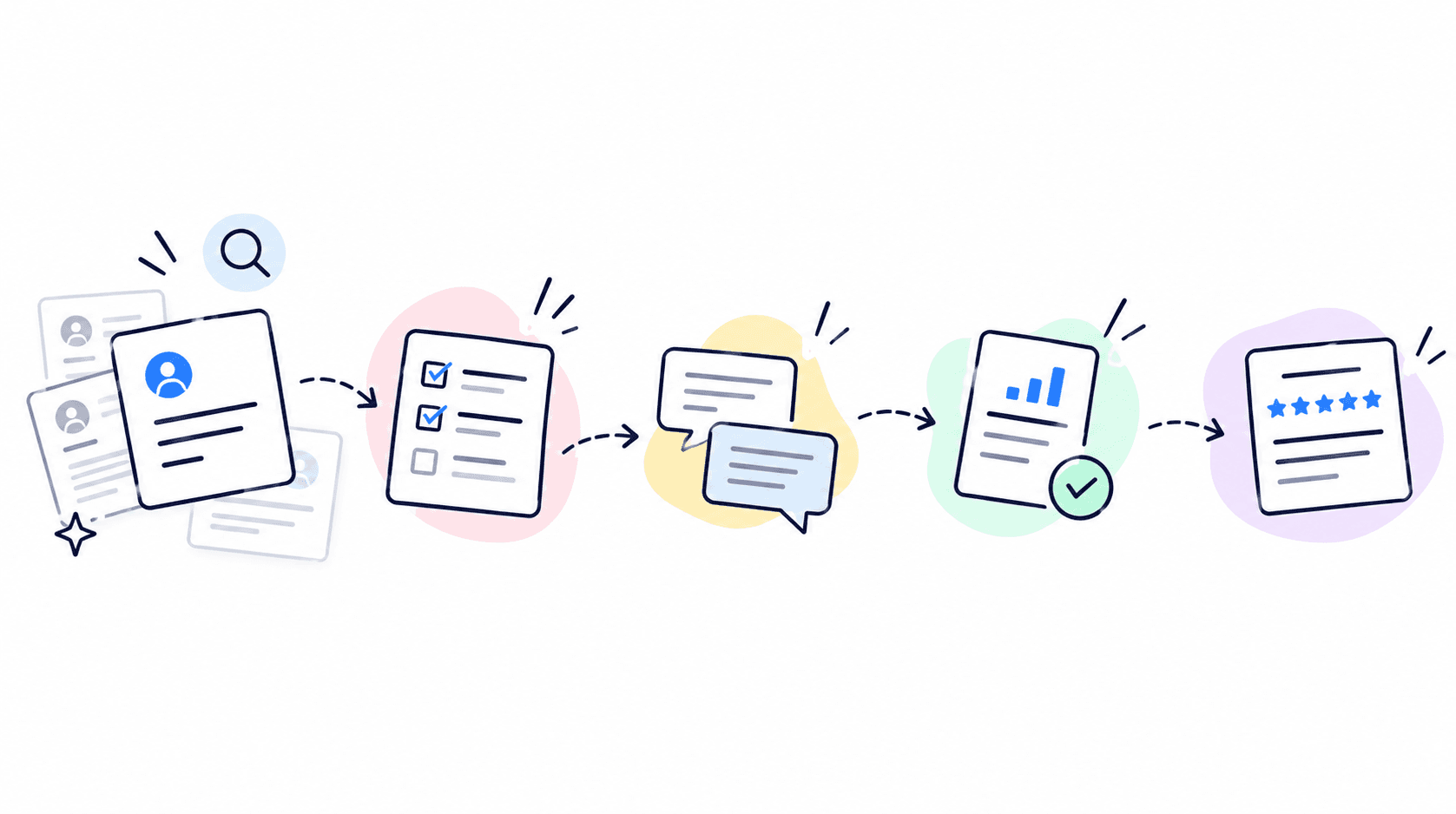
Hiring teams can collect a great deal of information about a candidate and still struggle to make that information useful at the moment it matters. A resume sits in one system. Outreach happens in another. Screening notes live in a document or conversation thread. Interview feedback arrives later, sometimes with little connection to the reasoning that brought the candidate into the process.
The problem is not always a lack of information. It is often a lack of continuity.
Candidate context in hiring means more than a profile, a resume, or a set of notes. It includes the relevant information and reasoning that help the next person understand why a candidate is being considered, what has been learned so far, what remains uncertain, and what should happen next.
When that context is not carried forward, teams repeat work, candidates repeat themselves, and decision makers may evaluate a person using only part of the picture. Understanding where context gets lost is the first step toward improving the hiring process.
For a broader look at how Talentz approaches connected hiring, visit the Talentz hiring platform.
What Candidate Context Actually Means
Candidate information is not the same as candidate context
Candidate information is the material a hiring team collects or records: work history, skills, portfolio links, answers to screening questions, availability, compensation expectations, interview notes, and other job-relevant details. Candidate context connects those details to the role and to the decisions being made.
For example, a resume may show that a software engineer worked on a retrieval system. Context explains why that experience matters for a particular role, which part of the project is relevant, what the recruiter verified, and what the hiring team still needs to assess. The distinction is not about adding more notes. It is about making useful reasoning available to the next person.
Context can include why a candidate was surfaced, which role requirements appear to match, what the candidate has said about the opportunity, what evidence supports a qualification, what questions remain open, and why the team is recommending a next step. Only relevant, appropriate, job-related information should be included.
Why the reason behind the information matters
A list of facts rarely explains itself. One interviewer may see a career move as a concern; another may understand it after reading the candidate’s explanation. A recruiter may have identified a project that maps to the role, but that connection can be invisible if the hiring manager receives only a profile.
When reasoning is missing, the next participant has to infer it, ask for it, or repeat the research. The process becomes more dependent on memory and informal communication than it needs to be.
Where Candidate Context Gets Lost Across the Hiring Process
1. From sourcing to outreach
Sourcing often begins with a hypothesis: this person may be relevant because of a particular project, technical skill, industry experience, or type of responsibility. If that reason is not carried into outreach, the next step may retain the candidate’s name and profile but lose the reason they were selected.
This can affect the quality of the conversation. A generic message may overlook the experience that made the candidate relevant. A recruiter may also need to revisit the original research to explain the match later.
A useful sourcing handoff preserves the role-related reason for interest, the evidence that supports it, and any uncertainty that still needs checking. It should not turn a preliminary hypothesis into a confirmed qualification.
2. From outreach to screening
Candidate conversations create context that a profile cannot provide on its own. A candidate may clarify the scope of a project, explain what they want in their next role, ask about team structure, or flag a constraint that affects timing. These details can change the next action.
If screening starts elsewhere, the recruiter may ask questions that have already been answered or miss an important concern. The candidate experiences repetition, while the team loses a chance to build on what it already knows.
The answer is not to copy every message into every record. Capture the points relevant to the role and next decision, with enough attribution and recency that another person can interpret them correctly.
3. From screening to interview
Screening should help the team decide what to explore next. It may establish that a requirement appears to be met, identify a gap that needs deeper assessment, or surface a question for an interviewer. When the interview invitation contains only a resume and a calendar link, much of that preparation can disappear.
The interviewer may start from the beginning, focus on a different criterion, or duplicate earlier work. A stronger handoff identifies what has been established, what evidence supports it, what remains unverified, and which questions the interview should answer.
4. From interview feedback to the hiring decision
Interview notes are more useful when tied to the criteria the team agreed to assess. A rating without explanation may be difficult to interpret later. “Strong candidate” or “not a fit” records a conclusion but provides little insight into the evidence behind it.
When the team reviews feedback, it should be able to distinguish observations from interpretations and identify where interviewers agree or disagree. That makes discussion more precise. A connected process does not require everyone to agree; it helps the team understand what each assessment was based on and what still needs judgment.
Why Adding More Tools Does Not Necessarily Solve the Problem
A fragmented workflow can tempt teams to add another platform, spreadsheet, form, or dashboard. Each tool may solve a local problem, yet every additional transition creates a new question: where does information go next, who owns it, and how does the next person know what matters?
Tools are not automatically the cause of fragmentation. A team can have a small stack and still lose context through unclear ownership, inconsistent note-taking, or an undefined handoff. Multiple systems can work together when the workflow and information responsibilities are explicit.
Before selecting software, map the process. Identify the source of truth for each type of information, the person responsible for maintaining it, and the moment another participant needs it. Then decide whether current systems support that movement or a new capability is necessary.
What Happens When Each Hiring Step Starts From Scratch
Repeated work consumes attention
When context is missing, recruiters reconstruct sourcing decisions, candidates repeat details, and interviewers search for background before a conversation. Each instance may seem small. Across a role or a team, repeated work can absorb time that would be better spent on evaluation and candidate communication.
Candidates experience an inconsistent process
A candidate may explain a preference to one recruiter and then be asked the same question by someone else. They may hear different descriptions of the role from different interviewers. Some repetition is reasonable when a detail must be verified, but unnecessary repetition can make the process feel disconnected.
Continuity does not mean every participant should know every detail. It means the team should avoid asking candidates to restart conversations simply because information did not reach the right person.
Decisions can be based on different slices of the picture
If each participant sees a different subset of information, their conclusions may not be comparable. One person may focus on a resume; another has seen a portfolio; another relies on interview feedback. The resulting discussion can become a debate about impressions rather than job-related evidence.
A useful process makes relevant evidence visible and keeps its limits clear. It does not eliminate disagreement or guarantee a correct decision. It gives the team a better basis for judgment.
What a Connected Hiring Workflow Looks Like
Start with the candidate journey, not the tools
A connected hiring workflow begins by mapping the real journey from role definition through sourcing, outreach, screening, interviews, and decision. At each stage, ask what is created, what changes, who needs it next, and what action it should support.
This exercise often reveals that teams have documented activities but not handoffs. “Complete screening” is an activity. “Give the interviewer relevant qualification evidence, candidate questions, unresolved concerns, and the criteria to assess next” is a handoff with a clear purpose.
Preserve the context that changes the next action
Connected does not mean sending everything to everyone. Too much information can be as unhelpful as too little. A useful handoff is selective: it contains the information the next participant needs to act, the reasoning behind important conclusions, and the questions that remain open.
· Role-related evidence: What relevant experience or capability has been observed?
· Source and confidence: Where did the information come from, and how certain is the team?
· Candidate context: What relevant preferences, questions, or constraints have been shared?
· Open questions: What has not yet been established?
· Next action: What should the next participant assess, confirm, or communicate?
Adapt this structure to the role and stage. It is a guide for useful continuity, not a reason to collect unnecessary personal information.
Keep the hiring manager responsible for the decision
Workflow tools can organize information, reduce repetitive administration, and make relevant context easier to review. They should not turn a recommendation into an unquestioned decision. The hiring team remains responsible for assessing job-related evidence, resolving uncertainty, and deciding whether a candidate should move forward or receive an offer.
A well-designed workflow makes human judgment better informed. It does not remove accountability from the people making the decision.
Where AI Can Help Preserve and Use Context
AI can support workflow continuity when it helps organize, summarize, retrieve, or connect relevant information that already exists in the process. For example, an AI-enabled workflow may help prepare a concise handoff summary from approved notes or surface an unanswered question before the next stage. These are general design possibilities, not claims about a specific product unless its capabilities have been verified.
The central design question is not “How much can be automated?” It is “Which part of the workflow benefits from assistance, and what must a person review before acting?”
Any AI-generated summary should preserve source distinctions and uncertainty. It should not turn a candidate’s statement into a verified fact, treat an inference as evidence, or omit a caveat that changes interpretation. Teams should establish appropriate access controls, retention practices, and review processes for candidate information.
What Should Remain Human in the Decision Process
Hiring decisions involve context, trade-offs, and accountability. Automation can help a team prepare and organize its work, but people must decide how evidence relates to the role, what uncertainty is acceptable, and whether the candidate meets requirements.
Human review should be substantive rather than ceremonial. Reviewers need enough time and information to question a summary, examine the underlying evidence, and correct errors. A system that presents a confident conclusion without making its basis understandable can create a new form of context loss.
Talentz’s approach is built around connecting work across the pre-hire process while keeping people responsible for hiring decisions. Learn more about Talentz’s approach to hiring decisions.
A Practical Candidate Context Audit
Choose one active role and review a small sample of candidate journeys. Do not begin by buying a new tool. Begin by following the information.
1. At sourcing, can the team explain why each candidate was considered relevant to the role?
2. At outreach, can the person handling the conversation see the reason for contact and relevant role context?
3. At screening, are useful candidate responses and open questions recorded where the next participant can access them?
4. Before interview, does the interviewer know what has already been assessed and what they are expected to learn?
5. At the decision stage, can the team connect conclusions to job-related evidence and identify unresolved questions?
For each handoff, record three things: what the next person knows, what they still need to ask, and what they have to reconstruct. The patterns will show where continuity is breaking down.
How Talentz Thinks About a More Connected Hiring Workflow
The goal of a connected hiring workflow is not to create a larger record of every candidate. It is to keep useful context available as the candidate moves through the process.
Talentz is building Zee as an agentic recruiting platform for a more connected pre-hire workflow. The aim is to help connect work across stages while people remain responsible for evaluating candidates and making hiring decisions.
Explore how Zee connects the hiring process to understand how a connected workflow can be approached from role definition through candidate evaluation and handoff.
Conclusion: Keep the Reasoning With the Candidate
A candidate should not become a new research project at every hiring step. If a team repeatedly reconstructs why someone was sourced, what they have said, or what an interview established, the workflow is not carrying enough useful context forward.
Start by mapping the candidate journey and examining the handoffs. Decide what the next participant needs to know, where that information should live, and who is responsible for keeping it useful. Add technology only when it supports that design.
Talentz is building Zee to support a more connected pre-hire workflow.
Frequently Asked Questions
1. What is candidate context in recruiting?
Candidate context is the job-relevant information and reasoning that help a hiring team understand why a person is being considered, what has been learned, what evidence supports a qualification, and what still needs to be assessed.
2. Why does candidate information get lost between recruiting stages?
Information may be recorded in different systems, passed through informal messages, shortened during summaries, or left out because ownership is unclear. It can exist somewhere without being accessible or useful to the next participant.
3. How can recruiters improve candidate handoffs?
Use a consistent structure that includes role-related evidence, the source of important information, relevant candidate questions or constraints, unresolved points, and the next action. Keep it concise and tailored to the stage.
4. How can AI help maintain candidate context?
AI may help organize, summarize, retrieve, and connect relevant information. Teams should verify summaries, preserve uncertainty, protect candidate information, and keep people accountable for hiring decisions. See the Talentz FAQ for more information about Zee and the role of human review.