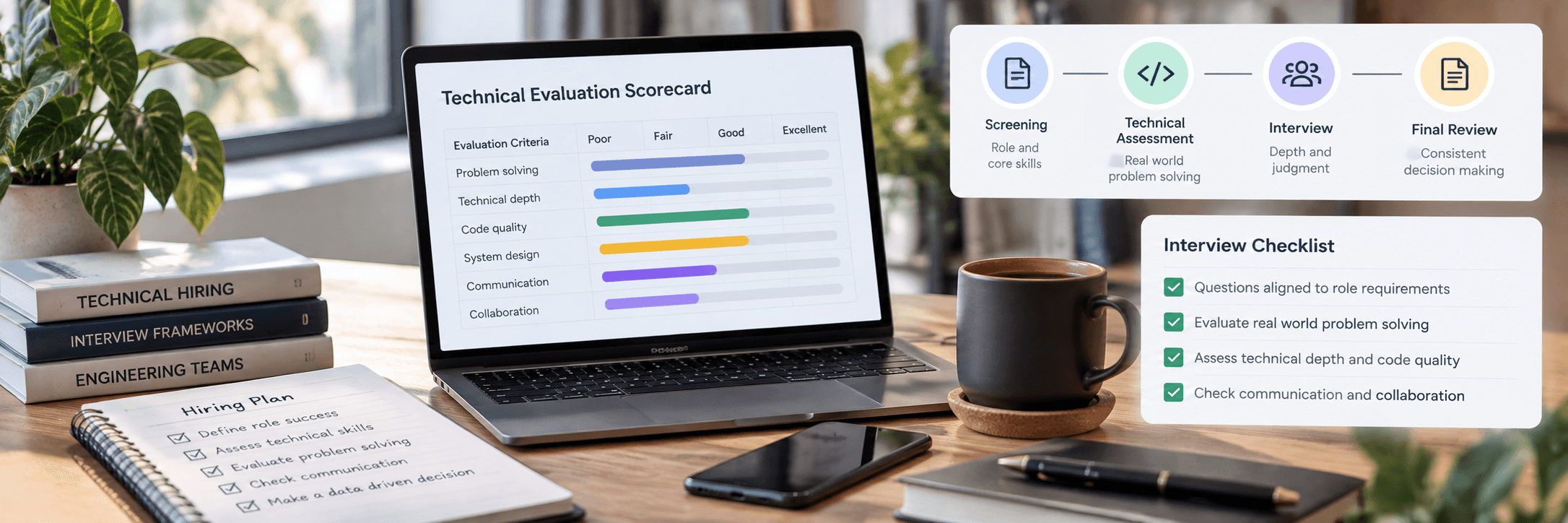
When a technical hire is difficult to make, the first response is often to add another step. A team may introduce a second coding exercise, ask another engineer to interview the candidate, or add a final conversation to resolve concerns raised earlier.
Sometimes an additional assessment is justified. A role may require a capability that has not yet been tested, or the existing process may be missing an important perspective. But adding stages without reviewing the process can create a longer journey without producing a clearer decision.
To improve your technical hiring process, start by asking what the team needs to learn about a candidate, where that evidence should come from, and how it will be used. The aim is not simply to reduce the number of interviews. It is to make every stage useful, relevant to the work, and clear to the people involved.
A well-designed process gives engineering teams a more consistent way to evaluate technical capability, problem-solving, collaboration, and role-specific judgment. It also gives candidates a clearer sense of what they are being asked to demonstrate and why.
Why technical hiring processes keep growing
Technical roles can be difficult to assess because the work is varied and context-dependent. A software engineer may need to design systems, debug production issues, work with legacy code, review other people’s work, communicate trade-offs, or deliver under operational constraints. No single question or test can reveal everything about that work.
The difficulty is that teams often respond to uncertainty by adding another assessment instead of identifying what remains unknown.
A coding exercise may be followed by a live coding interview that tests much the same skill. A system design conversation may overlap heavily with an architecture discussion. Several interviewers may ask candidates to describe the same project because no one has agreed who owns which evaluation area. Each stage feels reasonable on its own, but the process as a whole becomes repetitive.
Other causes include:
· The role is not defined precisely enough. Interviewers do not know which capabilities matter most, so they test whatever they personally consider important.
· The team has not agreed on what counts as sufficient evidence. A candidate can pass one stage and still be asked to repeat the same assessment because the next interviewer does not trust or understand the earlier feedback.
· A past hiring mistake shapes the process. After a difficult experience, a team adds a test to catch that problem without checking whether the new test measures it reliably.
· Interview ownership is unclear. Multiple people cover the same topic while another important capability receives little attention.
· The process is designed around interviewer preferences. Each person adds a favorite question or exercise, rather than working within a shared plan.
· The hiring team confuses more information with better information. A long collection of ratings is not automatically more useful if the ratings are vague, inconsistent, or unrelated to the job.
The result is not necessarily a bad process. It is a process that may have accumulated stages without a deliberate review of what each stage contributes.
Start with the work the engineer will actually do
Before changing the interview plan, return to the role. A useful technical hiring process begins with a clear view of the work, the level of independence expected, and the decisions the person will make.
A backend engineer maintaining a high-volume service may need to reason about reliability, observability, data consistency, and incident response. An engineer joining an early-stage product team may need to make trade-offs with incomplete information, work across the stack, and adapt as requirements change. An AI engineer may need to evaluate model behavior, design data pipelines, understand failure modes, or explain the limitations of an approach to non-specialists.
These roles can share programming languages and job titles while requiring different evidence. If the team starts from a generic interview template, it risks measuring skills that are easy to test rather than the capabilities that matter most.
Write down three to five priority outcomes for the role. For each outcome, identify the capabilities required and the evidence that could demonstrate them. The outcome might be to design a service that can be operated safely, improve the performance of a slow system, or turn an unclear product need into a maintainable implementation.
Then ask what level of performance is expected. Is the person expected to learn with guidance, deliver independently, lead technical decisions, or set direction for others? Seniority should affect the complexity and independence of the evidence sought, not simply the difficulty of a puzzle.
If the team needs help clarifying the role before designing the process, the companion guide on defining role requirements before sourcing provides a practical starting point.
Define what each interview stage needs to learn
Once the role is clear, assign a purpose to every stage. Each interview should answer a defined question about the candidate’s ability to do the work. The question should be specific enough to guide the interviewer and useful enough to inform the decision.
For example, a technical hiring process might include an initial conversation to confirm role expectations and relevant experience, a technical exercise to explore problem-solving, a system design discussion for a role that requires architecture decisions, and a collaboration or leadership conversation where those capabilities are genuinely part of the job.
That is only an illustration, not a recommended sequence for every engineering role. Some roles need a work sample; others may be assessed more appropriately through a portfolio discussion, structured technical conversation, or review of previous work. The right design depends on the role, the level, the constraints, and the evidence already available.
For each stage, document:
· The question it answers: What do we need to learn here?
· The capability assessed: Which role requirement does it connect to?
· The method: Why is this interview, exercise, or discussion appropriate?
· The evidence expected: What should the interviewer observe or record?
· The owner: Who is responsible for evaluating this area?
· The handoff: How will the result inform the next step or final decision?
This simple map helps reveal gaps and duplication. If two rounds have the same purpose and produce the same kind of evidence, the team should explain why both are needed. If an essential capability has no assessment owner, the process has a gap.
Audit every round before adding another
A practical way to improve your technical hiring process is to audit the full sequence, not only the stage that prompted the latest concern. Start by listing every step from the first recruiter conversation to the final decision. Include take-home tasks, informal conversations, portfolio reviews, reference checks, and any additional steps used for particular candidates.
Then review each stage against the role criteria.
Find duplicated assessment
Two stages may use different formats while measuring the same capability. For instance, a candidate might complete a timed coding exercise and then spend a live interview solving a very similar problem. That may be appropriate if the live session tests reasoning and communication that the first exercise cannot reveal. If it merely repeats the same task, the team should reconsider the design.
Duplication is not always obvious from the interview titles. Ask interviewers to describe what they are assessing and what evidence they expect. Compare those answers rather than assuming that “technical screen” and “coding interview” cover different ground.
Identify stages that do not change the decision
A useful stage should provide evidence that the team will actually use. If the result rarely affects the decision, if no one can explain what it measures, or if the same concern is already assessed elsewhere, the stage deserves review.
That does not mean every stage must independently approve or reject a candidate. Some stages provide context or help the team interpret other evidence. The important point is that the contribution should be clear.
Check for gaps, not just excess
Removing a duplicate assessment is only one part of the work. A shorter process can still be weak if it never assesses an important capability. A team hiring a technical lead, for example, may need evidence of decision-making, mentoring, or cross-functional communication in addition to technical depth. A process designed only around coding speed would not answer the full hiring question.
The goal is coverage without unnecessary repetition. Each priority capability should have an appropriate way to be assessed, and each assessment should have a clear purpose.
Choose technical assessments that resemble the job
A technical assessment is most useful when it helps the team understand a capability that matters in the role. It does not need to reproduce the job exactly, and it should not create an unreasonable burden for candidates.
Different methods reveal different kinds of evidence:
· Structured technical conversation: Useful for exploring how a candidate approaches a problem, explains trade-offs, and responds to new information.
· Work sample: Can show how a candidate handles a representative task, provided the task is proportionate and the evaluation criteria are clear.
· Portfolio or project discussion: Helps the team understand a candidate’s contribution to previous work, including decisions, constraints, collaboration, and lessons learned.
· System design discussion: Appropriate where the role requires architectural judgment, trade-off analysis, or understanding how components behave together.
· Debugging or code review exercise: May be more relevant than writing code from scratch for roles focused on maintenance, reliability, or improving an existing codebase.
· Scenario-based discussion: Can help assess operational judgment, incident response, prioritisation, or how a person would approach a realistic constraint.
No method is automatically best. A take-home exercise can provide a useful sample of work, but it may also demand substantial unpaid time or favor candidates with more free time. A live coding session can reveal reasoning as it happens, but time pressure may affect what the team observes. A portfolio can provide rich context, but the interviewer needs to establish what the candidate personally contributed.
Choose the method because it fits the capability, not because it is fashionable or familiar. Tell candidates what the assessment is intended to explore, what tools or resources they may use, how long it should take, and what the team will evaluate. Clear instructions are part of a fair process.
Use a consistent evaluation rubric
An assessment can be relevant and still produce inconsistent feedback if interviewers use different standards. One interviewer may value speed, another may value clarity, and a third may focus on whether the candidate chose the same approach they would have chosen.
A rubric gives interviewers a common frame of reference. It should describe the capability being assessed and the evidence that would support different ratings. Avoid vague labels such as “good culture fit” or “strong engineer” unless they are translated into specific, job-related behaviors.
For a system design discussion, criteria might include how the candidate clarifies requirements, identifies constraints, explains trade-offs, considers failure modes, and adapts the design as conditions change. For a debugging exercise, criteria might include how the candidate gathers evidence, narrows possible causes, validates a hypothesis, and communicates uncertainty.
The rubric should not prescribe one correct solution when several approaches could be reasonable. Instead, it should help interviewers assess the quality of the candidate’s reasoning in context. A strong answer may be one that identifies assumptions and trade-offs clearly, even if it differs from the interviewer’s preferred design.
Structured interviews have a substantial research literature, and research reviews have generally found that structure can improve the consistency and usefulness of interview evaluations. The practical lesson is not that every conversation must be scripted word for word. It is that role-relevant criteria, planned questions, and clear scoring standards help teams make comparisons on a more defensible basis. The exact design should still fit the capability being assessed and the limits of the evidence.
Record reasons, not just ratings. A score of “3” does not tell the hiring manager what the candidate did well, what was missing, or whether the concern matters to the role. A short note tied to the rubric is more useful than a general impression.
Align interviewers before candidates enter the process
Interviewer alignment should happen before the first interview, not after conflicting feedback appears.
Share the role outcomes and scorecard with everyone involved. Explain which capabilities each person owns, what the rating criteria mean, and how feedback should be recorded. If interviewers need to ask follow-up questions, make sure they understand the boundary between exploring evidence and changing the assessment into a different test.
A brief calibration conversation can help. Use a sample answer or hypothetical response to discuss what strong, adequate, and insufficient evidence would look like. The purpose is not to force identical opinions. It is to make sure the team is applying the same criteria and can explain differences in judgment.
After interviews, collect feedback before the group discussion where practical. This reduces the risk that the first or most senior opinion shapes everyone else’s assessment. During the debrief, discuss evidence against the criteria, resolve contradictions, and identify what remains uncertain. Avoid letting confidence, similarity, or personal rapport substitute for evidence of capability.
The hiring manager should remain accountable for the final hiring decision. Interviewers contribute assessments; they do not each make an independent hiring decision in isolation. The final decision should consider the full set of role-relevant evidence and the requirements agreed at the start.
Make the process clearer for candidates
Candidate experience is not separate from process design. Candidates invest time in preparation, scheduling, exercises, and conversations. When the purpose of each stage is unclear or the role changes between interviews, they have less information with which to decide whether the opportunity suits them.
Set expectations early. Explain the stages, the broad purpose of each assessment, the likely time commitment, and when the candidate can expect an update. If the process changes, explain why. Avoid adding an extra round at the last minute without a clear reason and a conversation about the additional time required.
Technical assessments should be proportionate. A task should be long enough to reveal the capability it is meant to assess, but no longer. If a realistic work sample would require many hours, consider a smaller exercise, a guided discussion, or a review of previous work. Make it clear whether the candidate can use documentation or tools, especially when those tools are normal parts of the job.
Consistency does not mean treating every candidate as if their circumstances are identical. It means assessing the same role requirements fairly while making reasonable adjustments where appropriate. A clear process helps candidates understand what is expected and gives interviewers a better basis for comparing relevant evidence.
Measure whether the technical hiring process is improving
A process should be reviewed using evidence, not only opinions about whether it feels faster. Teams can track a small set of measures that reflect both efficiency and decision quality. Use definitions consistently and interpret results in context.
Useful measures may include:
· Time between stages: Shows where scheduling or decision delays accumulate.
· Candidate time commitment: Estimates how much time the process asks candidates to invest, including take-home work.
· Stage completion and withdrawal patterns: Can highlight points where candidates commonly stop participating, although the reasons need to be investigated rather than assumed.
· Interviewer workload: Helps identify repeated effort, difficult scheduling, or unnecessary coordination.
· Feedback completeness: Shows whether interviewers are providing evidence tied to the agreed criteria.
· Decision usefulness: Ask whether each stage resolved a relevant question or changed the team’s understanding of the candidate.
· Post-hire review: Where appropriate data is available, review whether the criteria used in hiring connect to the work people actually perform after joining.
No single measure proves that a process is effective. A shorter time to hire can be positive, but speed alone does not show that the team assessed the right capabilities. A high pass rate may mean the sourcing pool is well aligned, or it may mean the assessments are too easy. A low pass rate may indicate a mismatch in sourcing, an unrealistic brief, or a poorly designed test.
Review measures alongside candidate and interviewer feedback. Look for patterns over time, and avoid drawing strong conclusions from a small number of hires. Most importantly, do not claim that fewer interview rounds automatically produce better hiring. The right outcome is a process that gathers enough relevant evidence to support a sound decision without avoidable repetition.
A five-question technical hiring process audit
Use these five questions for every stage in the current process:
1. What role requirement does this stage assess? If there is no clear connection, the stage may be measuring a preference rather than a job need.
2. What new evidence should it produce? Describe what the team expects to learn, not just the format of the interview.
3. Is the same capability already assessed elsewhere? If so, explain why another assessment adds value or redesign the sequence.
4. How will the evidence be evaluated? Define the criteria, rating standards, and person responsible for recording feedback.
5. Who uses the result, and how does it affect the decision? A stage should contribute to the decision or provide context that the team can explain.
Worked example: reviewing a process for an AI engineer
The following example is illustrative and is not a report of a Talentz customer outcome.
Imagine a team hiring an AI engineer to build and maintain an evaluation workflow for a product. Its current process includes a coding exercise, a second coding interview, a general technical conversation, a system design interview, and a final discussion with the engineering manager.
The audit finds that both coding stages focus on algorithmic problem-solving, while the role requires more emphasis on data quality, evaluation design, error analysis, and communicating limitations. The general technical conversation also repeats questions already asked by the manager.
The team does not simply remove two rounds. It first identifies the capabilities that matter, then redesigns the stages so that each contributes different evidence. One stage explores implementation and debugging, another examines how the candidate would design and interpret an evaluation, and the manager conversation focuses on ownership, trade-offs, and collaboration. The precise sequence would depend on the role and the evidence already collected.
The improvement comes from better coverage and clearer purpose, not from a predetermined number of interviews. The team can then review candidate feedback, interviewer workload, and the usefulness of each stage to see whether the revised process is working as intended.
Where a connected hiring workflow can help
Even a well-designed interview process can lose context if information is scattered across documents, messages, and separate systems. The role criteria may be agreed during intake, but the recruiter may use a shortened version in outreach. Interviewers may receive different instructions. Feedback may arrive without a clear link to the original requirement.
A connected workflow helps carry the same role context from intake through sourcing, candidate conversations, assessment, and decision-making. It does not remove the need for judgment. It makes it easier for the people involved to work from a shared understanding and to see why a particular piece of evidence matters.
The Talentz approach to hiring decisions centers on making role criteria and evidence more useful throughout the hiring process. Zee supports a more connected workflow. The hiring team remains responsible for evaluating the evidence, weighing trade-offs, and making the final hiring decision.
Conclusion: Make Every Interview Stage Count
A technical hiring process does not become stronger simply because it has more rounds. Each stage should exist for a reason, assess a capability that matters to the role, and produce evidence the team knows how to use.
To improve a technical hiring process, start with the work the engineer will actually do. Define the required capabilities, map each one to a suitable assessment, and review every stage for duplication or gaps. Give interviewers clear evaluation criteria, record the evidence behind their ratings, and make the process understandable for candidates.
Then review how the process performs. Look at scheduling delays, candidate effort, interviewer workload, the quality of feedback, and whether each stage helps the team make a more informed decision. Use that information to adjust the process rather than adding rounds by default.
The goal is not the shortest possible process. It is a process that respects candidate time while giving the hiring team enough relevant evidence to make a careful decision.
Frequently asked questions
1. How can you improve a technical hiring process?
Begin with the role’s actual responsibilities and define the capabilities the team needs to assess. Give every interview stage a clear purpose, remove unnecessary duplication, use consistent evaluation criteria, and review candidate and interviewer feedback to identify where the process needs improvement.
2. How many interview rounds should engineering roles have?
There is no single number that fits every engineering role. The right number depends on the role’s scope, seniority, complexity, and the evidence required for a sound decision. Review each stage for its contribution instead of using a fixed number as the main measure of quality.
3. How do you avoid duplicate technical interviews?
Map each interview to a specific role requirement and ask what new evidence it should produce. Compare the responsibilities of interviewers, identify overlapping questions or exercises, and keep an additional stage only when its contribution is clear.
4. What should a technical interview evaluate?
It should evaluate capabilities that are important to the actual role. Depending on the work, these may include implementation, debugging, system design, technical judgment, communication, collaboration, operational thinking, or leadership. The team should define the relevant criteria before interviewing and use assessment methods suited to those criteria.