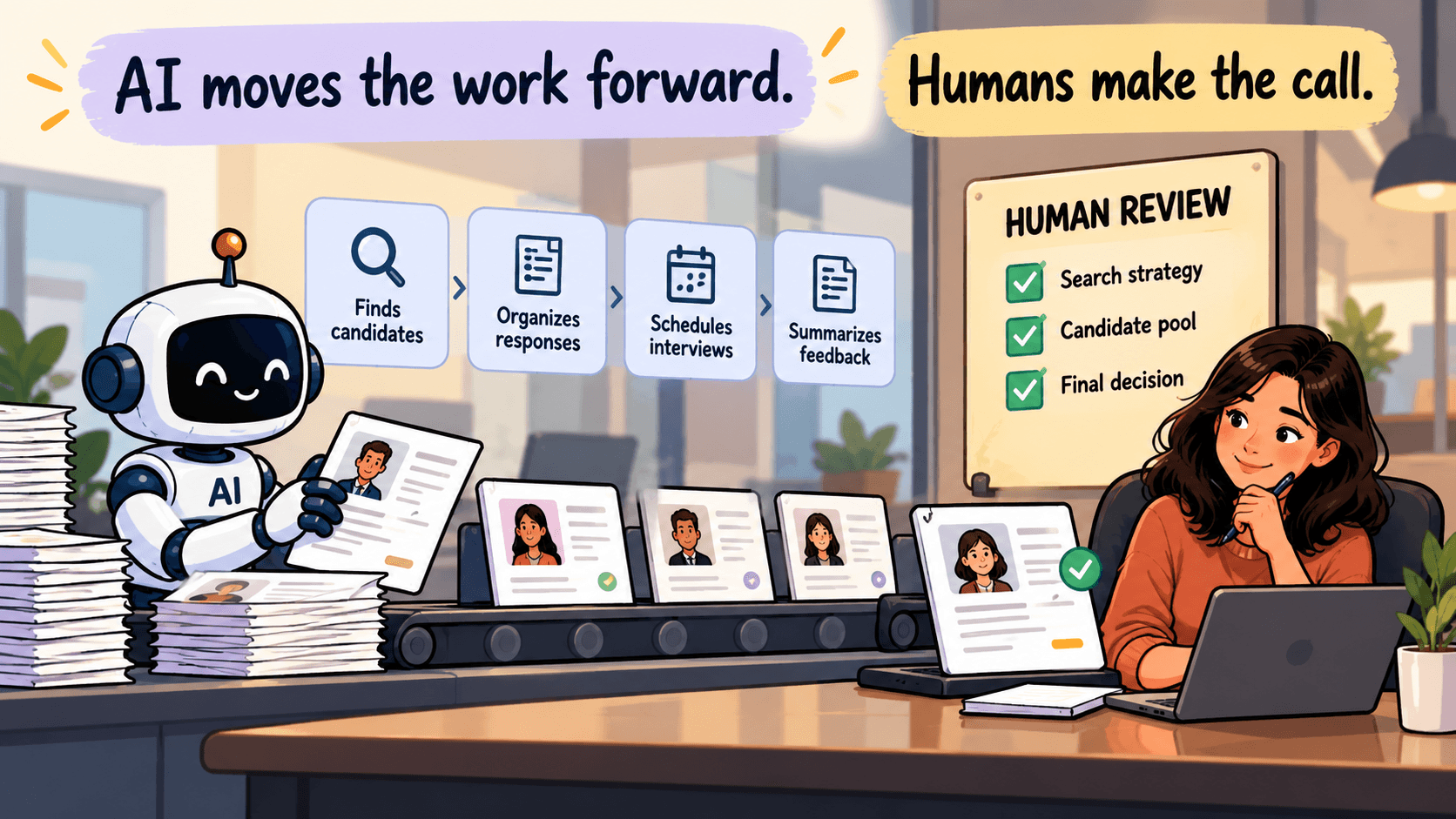
A recruiting workflow can look efficient on paper and still leave an important question unanswered: who is responsible when the system reaches a decision that affects a candidate?
AI may help organize candidate information, support search, coordinate conversations, and structure interview findings. But moving work through a process is not the same as deciding who should be hired. The point at which a system can continue, must pause, or needs a person to make a judgment should be explicit before the workflow goes live.
That is the practical meaning of human-in-the-loop AI recruiting. Human involvement is not a vague promise at the end of a product description. It is part of how responsibilities, approvals, exceptions, and records are designed.
For hiring teams, the central question is not simply whether a human appears somewhere in the process. It is whether the right person has the information, authority, and time needed to make the decision that belongs to them.
What human-in-the-loop means in recruiting
Human-in-the-loop describes a workflow in which people retain defined responsibilities for reviewing, approving, correcting, or deciding at points where human judgment is required. It does not mean that a person must manually perform every routine task. Nor does it mean that a quick approval click automatically makes a process responsible.
The arrangement should answer four practical questions:
· Who owns this decision? The system, the recruiter, the hiring manager, or another designated reviewer?
· What information supports it? The reviewer should be able to see the relevant criteria, evidence, uncertainty, and history.
· What causes a handoff? The workflow needs a defined condition that pauses or routes work to a person.
· What happens after review? The decision, rationale, and next action should be recorded clearly enough for the team to understand what occurred.
The answers will vary by organization and role. The important part is to establish them before the system is handling live candidates, not after an exception reveals a gap.
Why a human review checkbox is not enough
It is easy to write “a human makes the final decision” into a policy. It is harder to ensure the workflow actually behaves that way under normal conditions and when something unexpected happens.
Imagine that a candidate pool is generated and the next automated step is outreach. If the team is expected to approve that pool first, the workflow should wait for the approval. If outreach starts before the review happens, the approval exists only as a statement, not as an operational control.
The same problem appears when a system surfaces a recommendation without showing the evidence behind it. A reviewer may technically be involved, but if the information is hidden, incomplete, or difficult to interpret, meaningful review becomes harder. A process that asks people to approve outputs they cannot adequately examine invites rubber-stamping.
A useful test is simple: if the human reviewer disagrees with the system, can they understand what led to the output, challenge it, and change the next step? If not, the human role may be nominal rather than effective.
Map decision boundaries across the recruiting workflow
A practical design starts by mapping the workflow from role intake through the hiring decision. Do not begin by asking which tasks can be automated. Begin by identifying the decisions the process must make, who is accountable for each one, and what information is required to make them.
1. Role definition and search strategy
Before the search starts, someone needs to define what the team is looking for. That includes the role outcomes, criteria that matter, genuine constraints, and which requirements are preferences rather than hard boundaries. AI can help apply an agreed brief, but it should not silently redefine the role based on patterns in available data.
A clear approval point confirms that the search strategy reflects the hiring team’s intent. If the brief is incomplete or the criteria conflict, the workflow should route the issue back to the person who owns role definition.
2. Candidate pool review
Candidate discovery can return people with different career paths, titles, portfolios, and forms of experience. A reviewer should be able to understand why profiles have been surfaced and what still needs to be checked. Where the workflow calls for approval before outreach or progression, that review should be a real gate.
A candidate pool should not be treated as self-validating simply because it was generated by software. The purpose of review is to assess whether the result fits the approved role criteria and whether the team needs to refine the search.
3. Candidate conversations and structured interviews
Routine coordination and organizing conversation records may be suitable for automation. Questions about conflicting information, unclear consent, a request for accommodation, or a situation outside the workflow’s defined boundaries may require a human response. The design should specify how such cases are recognized and routed, rather than expecting an agent to improvise outside its remit.
During interviews and evaluation, AI-supported summaries can help organize findings, but a summary should not replace access to the underlying evidence. The reviewer needs enough information to assess whether the conclusion is supported and whether an additional question is necessary.
4. Progression, rejection, and the final hire decision
Progressing a candidate, setting a candidate aside, and selecting a person for hire are consequential parts of the process. Teams should define which actions the system may prepare or recommend and which require a human decision. The hiring manager remains responsible for the final hire decision.
The record should not become detailed only for successful candidates. A clear record of why a candidate moved forward or was set aside helps the team reconstruct the process, review whether the agreed criteria were applied, and identify where the workflow needs attention. A record supports accountability; it does not make a decision correct by itself.
Design checkpoints that actually work
For every meaningful human checkpoint, write down five elements. These make a broad policy concrete enough to implement and test.
1. Trigger: What condition causes the workflow to pause? Examples include approval required before outreach, conflicting evidence, or a result that falls outside defined criteria.
2. Owner: Which role is responsible for reviewing the item, and who handles it if that person is unavailable?
3. Context: What information should be visible at the checkpoint, including the role criteria, supporting evidence, uncertainty, prior actions, and outstanding questions?
4. Permitted actions: Can the reviewer approve, reject, request more information, change the criteria, or route the case to another person?
5. Record: What is stored about the decision, including the outcome, rationale where appropriate, the reviewer, and the next step?
A checkpoint is incomplete when the workflow pauses but gives the reviewer no useful context, or when the reviewer can see the evidence but has no clear way to stop or change the process. Both the information and the control need to be present.
A useful design principle
The workflow should not proceed past a required decision point until the designated person has acted. The person should be able to understand what needs review and what will happen after the review.
Make the handoff useful for the person receiving it
A handoff is not complete just because a notification has been sent. The recipient needs a decision-ready view of the situation. That does not require a long report every time. It requires the right information for the question at hand.
For a candidate pool review, the handoff may include the approved criteria, the reason each profile has been surfaced, evidence that supports apparent fit, and items that need validation. For an exception, it may include what happened, which boundary was reached, what is unclear, and which action is waiting. For a progression or rejection decision, it should preserve the rationale in a form the organization can review later.
Avoid presenting a single score as if it explains the whole case. Scores can compress different kinds of evidence into one number and obscure the uncertainty or trade-offs that matter to a hiring manager. If a score is used, the surrounding evidence and limitations need to remain available.
The principle also applies to rejected or non-progressing candidates. A workflow that records only who advanced makes it harder to examine decisions across the full candidate pool. A consistent record can help the team distinguish between a clear mismatch, insufficient evidence, a role change, or a decision that deserves review.
Protect against rubber-stamping and automation bias
Adding a person to the workflow does not automatically remove risk. Reviewers may trust a system output because it appears precise, because the process is moving quickly, or because challenging it takes extra effort. A human checkpoint should therefore be designed to encourage review rather than passive acceptance.
· Show evidence next to conclusions. Make it easy to inspect the information behind a recommendation instead of presenting only a label or score.
· Ask for reasons on material decisions. A short, specific rationale is more useful than an unexplained approval state.
· Make disagreement possible. Reviewers need a clear way to correct a record, request further evaluation, or override a proposed next step.
· Sample decisions over time. Periodically examine both progressed and rejected candidates to identify patterns that merit investigation.
· Keep role criteria stable and visible. Changes should be deliberate and recorded, not improvised to support a preferred outcome.
These practices cannot guarantee fair or accurate outcomes. They make it easier to detect problems, question outputs, and improve the process based on what the review reveals. For broader perspectives on AI, hiring, and system risk, explore Tech Vibes.
Check the workflow before it goes live
A tabletop review can expose missing decision boundaries before a workflow is used with real candidates. Walk through ordinary cases and edge cases with the people who will operate the process.
· A candidate meets the visible criteria but the evidence is incomplete. Does the workflow request review, seek additional information, or continue?
· The search returns too few relevant candidates. Who can adjust the strategy, and how is the change approved?
· The system’s summary conflicts with the original interview notes. Can the reviewer inspect the source material and correct the record?
· A candidate asks a question or raises an issue that sits outside the approved conversation flow. Where does it go?
· The team sets a candidate aside. Can a reviewer later understand the criteria and evidence behind the recorded outcome?
· The hiring manager disagrees with a recommendation. Is there a clear way to change the next action without fighting the workflow?
Use the results to define the first version of the workflow, then revisit the design as the team learns. The goal is not to predict every possible situation. It is to make normal decision points explicit and give exceptions a responsible path.
How to evaluate human oversight in practice
Rather than treating human oversight as a binary feature, evaluate whether the workflow makes review effective. Useful questions include:
· Did every required checkpoint pause the workflow until the designated person acted?
· Could reviewers access the evidence needed to understand the output?
· Were escalations routed to the correct owner and resolved with a recorded next step?
· How often did reviewers override, correct, or request more information about system outputs, and what did those cases reveal?
· Could the team reconstruct both progression and rejection decisions from the available record?
· Did the process preserve candidate privacy and follow the organization’s approved data and retention practices?
These are process questions, not vanity metrics. An increase in human overrides does not automatically mean the system is failing; it may mean reviewers are catching issues or that the workflow boundaries need refinement. The team needs to understand the reasons behind the pattern before deciding what to change.
What this means for Talentz
Talentz approaches AI recruiting as a workflow that should help hiring teams move work forward while preserving decision ownership. Zee supports the pre-hire process across candidate discovery, conversations, and structured interviews. The hiring manager remains responsible for the final hire decision.
For teams evaluating an AI recruiting workflow, the useful questions go beyond whether it can complete a task. Ask where approvals happen, what the reviewer can see, how exceptions are handled, and what record remains after a decision. Those details help distinguish a workflow that merely moves quickly from one that can be examined and managed responsibly.
Learn more about Talentz or read about the approach on the About page.
To discuss how Zee could fit into your process, see the Zee workflow.
Build human oversight into the system, not around it
Human-in-the-loop AI recruiting works when human roles are explicit, decision boundaries are enforceable, handoffs include the right context, and important actions leave a reviewable record. It does not require people to manually handle every routine task. It does require the system to recognize when the next step is a decision that belongs to someone else.
Start by mapping the workflow, naming the owner of each decision, and defining what must be visible before that person acts. Test the expected path and the exceptions. Then review the outcomes and adjust the design where the process does not behave as intended.
The core idea is straightforward: automation can move the work forward, but responsibility should never become ambiguous along the way.
Frequently asked questions
What is human-in-the-loop AI recruiting?
It is an approach in which people retain defined responsibilities for reviewing, approving, correcting, or making decisions at specific points in an AI-supported recruiting workflow. The workflow should make those points and responsibilities explicit.
Does human-in-the-loop mean every recruiting task must be manual?
No. Routine and repeatable tasks may be automated where appropriate. Human involvement should be focused on decisions, exceptions, and situations where judgment or accountability is required.
Where should human review happen in AI recruiting?
Common checkpoints include approval of role criteria and search strategy, review of the candidate pool, handling exceptions, and decisions about candidate progression and hiring. The right boundaries depend on the process and the impact of each action.
How can teams tell whether human oversight is meaningful?
Check whether the workflow pauses when required, gives reviewers relevant evidence, allows them to challenge or change the next step, routes exceptions to a named owner, and preserves a usable record of decisions.
Does a human review step guarantee a fair hiring outcome?
No. A review step is one control, not a guarantee. Teams still need appropriate criteria, careful review, privacy and compliance practices, monitoring, and clear accountability for decisions.