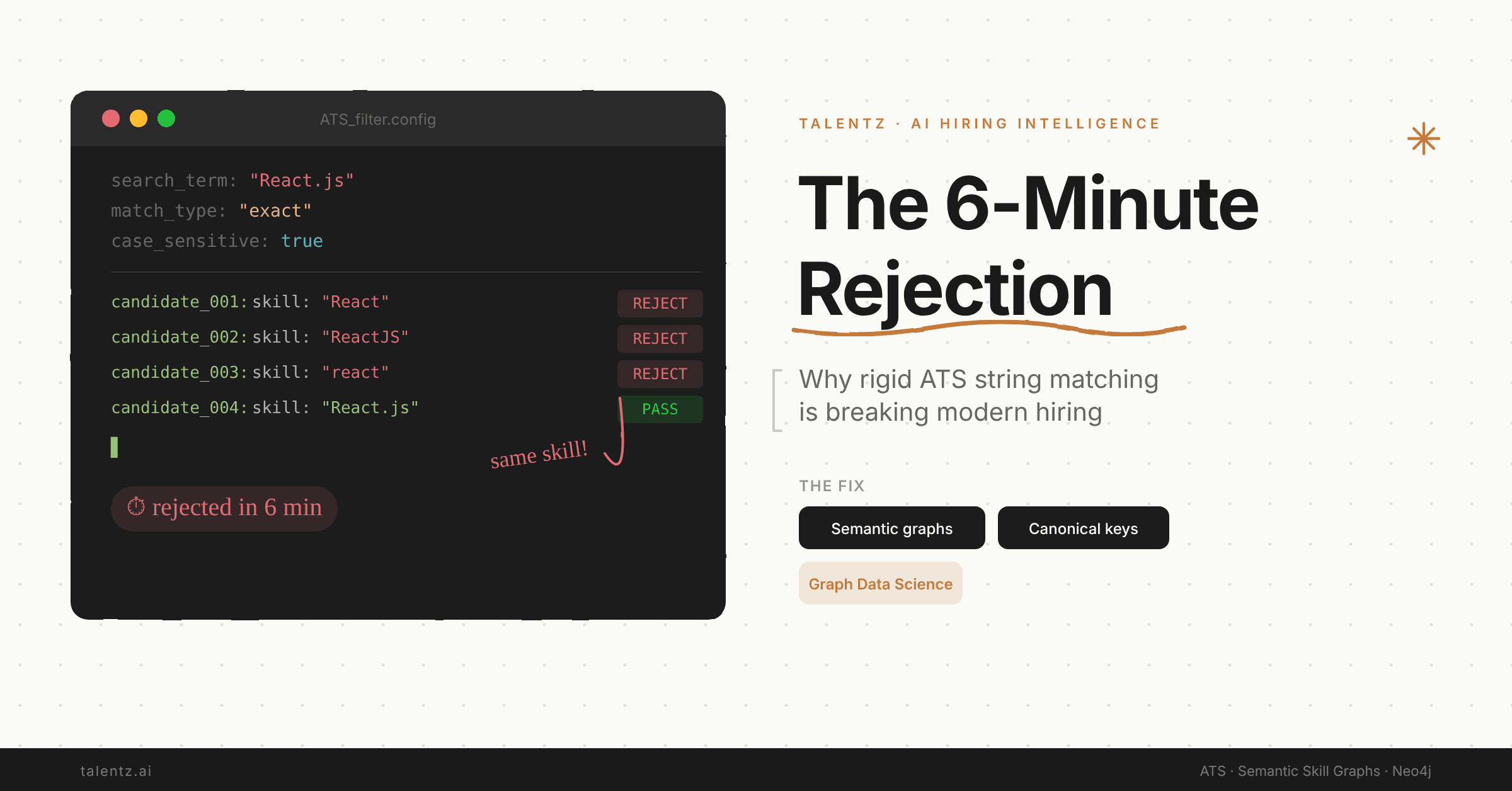
Picture this: You run an engineering team and need a senior hire urgently. HR has been stuck for weeks; nobody is making it through the automated screening. So you run a test. You create a fake email, build a resume that mirrors the job description word for word, and submit it. Auto-rejected in six minutes. After digging in, you find the reason: the ATS filter was hardcoded to search for "React.js." Your resume said, "React." One missing suffix. That's it. Qualified candidates had been filtered out for months while leadership complained about a tough talent market.
This isn't an edge case. It points to a structural problem in how most hiring systems are built: they treat skill matching as exact string comparison. But real skills don't live in a single canonical form. They appear across millions of resume variations: "React.js", "react", "ReactJS", and a system that can't see those as the same concept isn't really matching skills at all.
To fix talent intelligence, we need to move beyond flat lists and build semantic skill graphs. Here is how we tackled this at scale using Neo4j, automated normalization layers, and Graph Data Science (GDS) so candidates never get rejected over punctuation again.
The Root Cause: Why Flat Strings Break ATS Pipelines
Behind every 6-minute auto-rejection is a data engineering failure. When ingestion pipelines write raw text directly into a database, small variations create severe fragmentation:
The Case-Sensitivity Trap: Neo4j is strictly case-sensitive. If an ingestion batch inputs "Python", "python", and "PYTHON3" as separate strings, standard MERGE statements treat them as distinct nodes, scattering relationship edges across duplicate semantic fragments.
Punctuation and Whitespace Pollution: Variations like "Node.js" vs "nodejs", or trailing whitespace, cause exact-string lookups to fail, treating identical skills as total strangers.
Semantic Blindness: Beyond formatting, traditional filters treat text matching as binary. If a job description says "React.js" and a resume says "React", the system sees two different tokens. No understanding that these refer to the same technology. The candidate gets rejected over a missing suffix.
Enforcing Write-Time Hygiene with Canonical Keys
To stop duplicate nodes from polluting the graph, you can't rely on application-layer string trimming alone. You need a deterministic write contract:
- The Normalization Function: Pass every incoming skill name through a shared utility that strips whitespace, lowercases, and normalizes internal spacing.
- Canonical Keys and Constraints: Store both the display name and a unique canonical key.
- Pre-Merge Lookups: Before writing or merging any node, the ingestion script resolves existing nodes against the normalized key, preventing duplicate writes and structural loops.
Match-Time Resolution: Beyond Exact Strings
Even with a clean taxonomy, job descriptions and resumes will always use varied terminology. Instead of brittle exact-match queries, a production match-time resolver dynamically expands the search space:
The Resolver Pattern:
- Normalize the input string to match the canonical key.
- Find all matching Skill nodes in Neo4j.
- Expand one-hop equivalence relationships, aliases, synonyms, and abbreviations to build a comprehensive match set of equivalent terms.
This ensures that "React" and "React.js" resolve to the same underlying concept without requiring full-graph mass renames.
Graph Data Science in Action: Computing Similarity at Scale
Once the graph is clean, normalized, and structurally sound, you can move from static storage to dynamic intelligence using Neo4j GDS.
Smart Graph Projections: Isolate your working set into dedicated in-memory projections. Peer relationships are weighted numerically to reflect real-world relevance; a strong pairing like Python and pandas gets higher mathematical priority than a loose link like Python and project management. Keeping lateral peer links and vertical hierarchy relationships strictly separate ensures that structural inheritance and lateral similarity never cross-contaminate matching scores.
Node Similarity and Scoring: Run GDS similarity algorithms, Node Similarity or Cosine Similarity, over the projected graph. This lets your matching engine compare a job description's required skill cluster against a candidate's profile subgraph.
Ecosystem Discovery with Community Detection: Run community detection algorithms like Louvain over the taxonomy to automatically surface hidden technical stacks, adjacent skills, and intelligent "skills to learn next" recommendations for candidates.
Fixing the hiring funnel isn't about loosening filters. It's about upgrading the underlying data architecture. Combine deterministic normalization keys, strict write-time validation, alias expansion, and GDS similarity matching, and you transform a brittle keyword scanner into an intelligent semantic talent graph one where qualified candidates don't get rejected over a full stop.