Every AI recruiting vendor leads with time saved. Time-to-fill cut in half. Sourcing hours reduced by 70%. Hours per hire down from twelve to four.
These are real gains. But if you are evaluating whether an AI recruiting investment is working, time saved is the easiest metric to find and the least useful for making a decision. A system can dramatically reduce hours per hire while still consistently surfacing the wrong candidates, generating low offer acceptance rates, and contributing to attrition within 90 days. For more on what good candidate sourcing looks like before outreach even starts, see our AI candidate sourcing guide.
This guide focuses on the metrics that tell you whether AI recruiting is actually working: not how fast the system moves, but whether the candidates it finds, engages, and evaluates translate into hires who stay and perform. If you want a framework for measuring each stage of the workflow step by step, see How to Measure Progress in an AI Recruiting Workflow.
Why Time Saved Is a Weak ROI Signal
Time-to-fill and hours per hire are process efficiency metrics. They measure the speed of the funnel, not the quality of what comes out of it.
A recruiter who fills 20 roles in a quarter using AI tooling looks highly productive by efficiency metrics. But if 6 of those hires leave within 90 days, and 4 more are underperforming at their 6-month review, the efficiency gains disappear quickly when you account for replacement cost, onboarding time, and team disruption.
McKinsey estimates that the total cost of a bad hire can reach 30% of the employee's first-year salary for mid-level roles and significantly more for technical and leadership positions. For a $160,000 software engineer, that is a $48,000+ exposure from one bad placement.
AI recruiting tools that optimize purely for speed, moving candidates through the funnel faster, can actually increase the rate of bad hires if the underlying evaluation layer is weak. Speed applied to a flawed process produces flawed outcomes faster.
The Metric Most Teams Track vs. The Metrics That Matter
What most teams measure:
- Time-to-fill per role
- Sourcing hours per week
- Number of profiles reviewed
- Application-to-screen ratio
What tells you whether AI recruiting is working:
- Reply rate by channel and message type
- Shortlist-to-interview conversion rate
- Interview completion rate
- Offer acceptance rate
- 30-day, 60-day, and 90-day retention
- Quality of hire: performance rating or milestone completion within the first 6 months
The second list requires more effort to track. It also tells you something real.
The Metric Ladder: From Sourced to Decided with Evidence
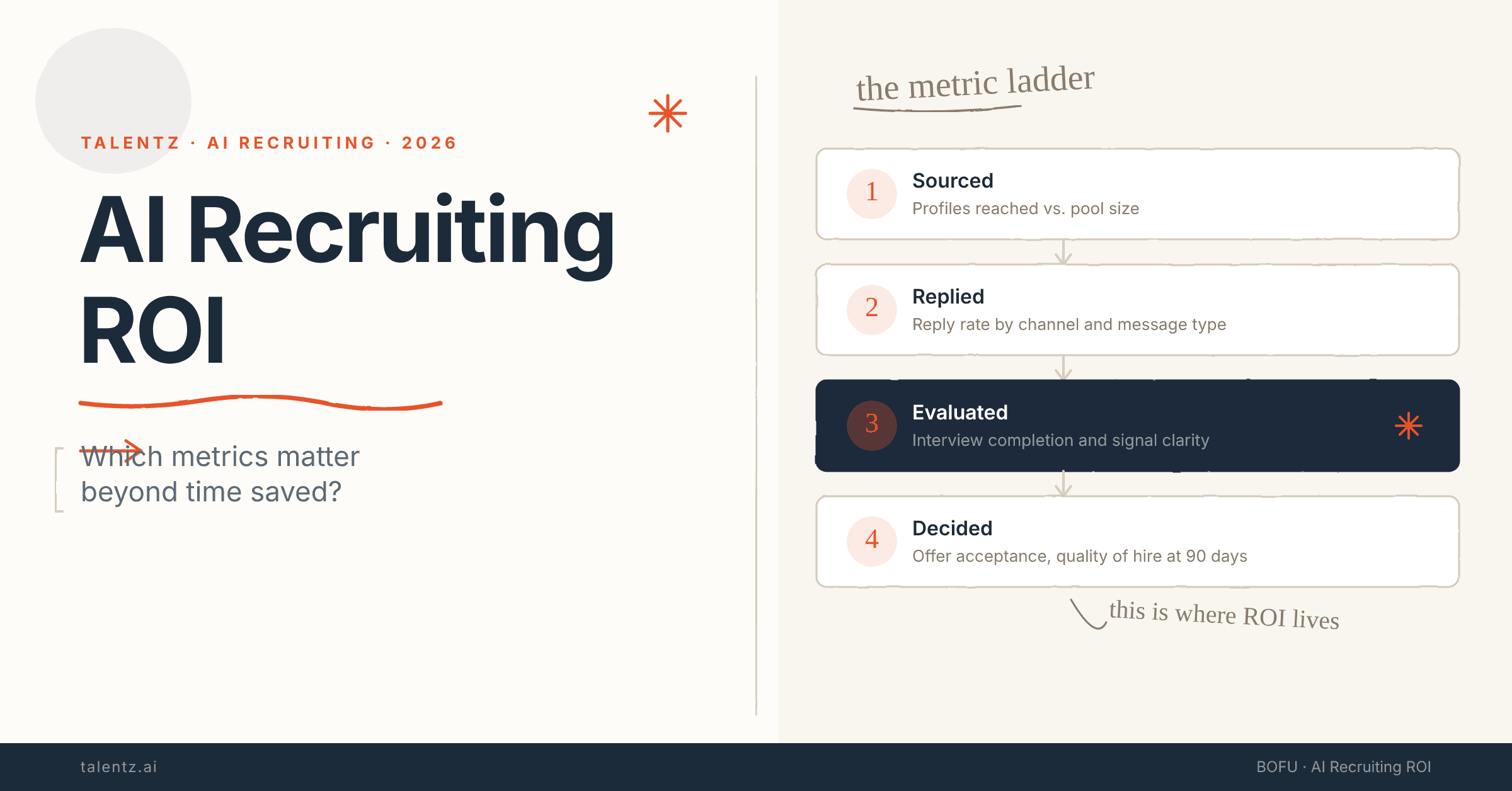
A useful way to think about AI recruiting ROI is as a ladder with four rungs. Each rung tells you something different about where the process is breaking.
Rung 1: Sourced
This measures whether the system is finding the right pool before outreach begins.
The question to ask: out of the total profiles reviewed, what percentage matched the brief closely enough to be shortlisted? If this ratio is very low, the sourcing layer has a signal problem. The system is not identifying the right candidates from the available pool.
For technical roles, relevant signals include verified project work, open-source contributions, employment history at comparable environments, and demonstrated skills in the specific stack the role requires. Resume keywords alone do not constitute a sourcing signal.
A useful benchmark to track over time is your shortlist hit rate: the percentage of sourced candidates who make it to a qualified shortlist without being filtered out at the next stage. If you are sourcing 400 profiles to get 10 shortlisted candidates, that is a 2.5% hit rate. Improving that number has a direct impact on recruiter time spent and candidate experience.
Rung 2: Replied
This measures whether the outreach is working, and specifically whether it is working for this role, this candidate pool, and this message type.
Reply rate varies significantly by channel (email vs. LinkedIn vs. text), by message tone (personal vs. templated), by role type (passive technical candidates respond very differently than active job seekers), and by timing (day of week and time of day have measurable effects on response rates).
For AI-driven outreach, the important distinction is between a system that sends the same template at scale and one that adapts based on what it knows about the candidate. A system that references a candidate's specific GitHub project or recent publication generates meaningfully higher reply rates than one that personalizes only by name and company.
A reply rate above 30% for cold outreach to passive technical candidates is achievable with well-constructed personalized messaging. Industry average for generic templated sequences is typically in the 10 to 15% range.
What reply rate alone does not tell you: whether the replies represent genuine interest or just curiosity. Track the conversion from reply to interview booking as a secondary signal.
Rung 3: Evaluated
This rung measures the quality of the evaluation layer. For AI recruiting, the relevant question is whether the interview or assessment process is measuring the right signals, and whether those signals actually predict performance in the role.
For a first-round evaluation, the metrics to watch are:
- Interview completion rate: what percentage of candidates who agree to an interview actually complete it? A low completion rate often points to a poor candidate experience or a mismatch between what candidates were told about the role and what they encounter in the interview.
- Signal clarity: for roles with structured evaluation criteria, can the evaluating system produce a clear recommendation with evidence? Or does the output require significant recruiter interpretation to be useful?
- Brief alignment: are the signals being measured in the interview actually the same signals that were defined in the original brief? Brief drift is a common failure mode in AI recruiting, where the evaluation layer gradually diverges from the original hiring criteria as the process progresses.
Rung 4: Decided with Evidence
This is the rung most directly tied to ROI, and the one most often skipped in ROI reporting.
The metrics at this rung are:
- Offer acceptance rate
- 30-day retention rate
- 90-day retention rate
- Quality of hire at 6 months
Offer acceptance rate is the first real test of whether the AI recruiting system understood the candidate as a person, not just a profile match. If candidates consistently reach the offer stage and then decline, there is a signal problem somewhere upstream: the brief was misaligned with candidate expectations, the outreach overclaimed about the role, or the evaluation process created a poor candidate experience.
Quality of hire at 6 months (meaning whether the hire is meeting role expectations as assessed by their manager) is the ultimate lagging indicator of AI recruiting ROI. It takes time to measure, which is why most teams skip it. But it is the number that tells you whether the efficiency gains were worth the investment.
How to Actually Calculate AI Recruiting ROI
A simple ROI calculation for an AI recruiting investment looks like this:
Start with what you paid: the total cost of the AI recruiting tool or platform over a defined period, including setup, integration, and recruiter time spent managing it.
Measure what you gained:
- Time savings: hours saved per hire multiplied by recruiter hourly cost multiplied by number of hires. This is the easy number.
- Reduction in bad hires: if quality of hire improved, estimate the cost avoided from fewer early attrition events. Use a conservative estimate of 20% of first-year salary as the cost of a bad hire for mid-level roles.
- Reduction in time-to-fill for critical roles: for roles where every week of vacancy has a measurable business cost, faster fill time has a real dollar value. Sales roles, for example, have a clear revenue-per-week cost from vacant headcount.
The number most teams leave out of this calculation is the bad hire reduction. Including it typically doubles or triples the apparent ROI of an AI recruiting investment.
Common AI Recruiting ROI Mistakes
Measuring efficiency, not effectiveness
Reducing time per hire is a process improvement. Improving quality of hire is a talent improvement. AI recruiting tools that do the first without the second are expensive search engines, not recruiting partners.
Treating reply rate as a vanity metric
High reply rates feel good. But if the candidates who reply are not converting to interviews, or are declining offers at high rates, the reply rate is measuring something other than genuine interest. Break it down: reply rate by channel, reply rate by role type, reply rate to interview conversion, interview to offer conversion.
Skipping the 90-day check
Most teams measure AI recruiting ROI at the offer stage. The 90-day check is where you discover whether the system actually evaluated the right signals. Building a lightweight 90-day retention tracker for AI-sourced hires, separate from the rest of your hiring data, is one of the highest-leverage investments you can make in improving your AI recruiting ROI over time.
Not controlling for role type
AI recruiting ROI varies significantly by role. For high-volume, well-defined roles with clear skill requirements, AI sourcing and screening tends to perform very well. For early-stage, ambiguous, or senior roles where culture fit and leadership signals matter as much as technical ability, the ROI calculation is more nuanced. Report AI recruiting ROI by role category, not as a single blended number.
What Good AI Recruiting ROI Looks Like
For a growth-stage company hiring primarily technical roles using an agentic AI recruiting platform:
- Shortlist hit rate above 15% (1 in 7 sourced profiles makes the qualified shortlist)
- Reply rate above 30% on first outreach
- Interview completion rate above 85%
- Offer acceptance rate above 70%
- 90-day retention rate for AI-sourced hires above 90%
- Quality of hire rating at 6 months comparable to or better than hires made without AI tooling
These are not benchmarks that every team will hit immediately. They are targets that improve over time as the system learns the brief, the candidate pool, and the patterns that predict success in your specific environment.
The Bottom Line
AI recruiting ROI is real, but it is not primarily measured in hours saved. The teams that see the highest return on their AI recruiting investment are those that measure quality of hire, track the full funnel from sourced to decided, and use those metrics to continuously improve the brief, the evaluation criteria, and the outreach approach.
Time saved is a by-product of a well-designed AI recruiting workflow. It is not the goal. The goal is better hires, made faster, who stay.
FAQ
What is the most important AI recruiting ROI metric?
Quality of hire at 90 days is the metric with the highest signal value. It is a lagging indicator that takes time to measure, but it tells you whether the AI recruiting system is selecting for the right signals. Teams that skip this metric often find that their apparent ROI calculations are based on efficiency gains that are partly offset by increased attrition.
How do I measure AI recruiting ROI without a large data set?
Start with the leading indicators you can measure immediately: shortlist hit rate, reply rate, and interview completion rate. These give you a signal within weeks rather than months. As you accumulate more hires, add offer acceptance rate and 90-day retention to the analysis.
What is a good reply rate for AI recruiting outreach?
For cold outreach to passive technical candidates, a reply rate above 30% is a strong result. The industry average for generic templated sequences is typically 10 to 15%. The difference comes almost entirely from personalization quality: whether the message demonstrates that the outreach system actually read the candidate's work, not just their job title.
Does AI recruiting ROI vary by role type?
Significantly. AI recruiting ROI tends to be highest for technical roles with clear skill requirements, mid-level positions where the candidate pool is large, and roles where the brief can be defined precisely. It tends to be lower for executive and leadership roles, early-stage positions where culture fit is a primary criterion, and roles that require extensive stakeholder alignment in the evaluation process.
How is Zee's ROI measured differently from other AI recruiting tools?
Zee is designed around the full workflow rather than individual steps, which means ROI is measured across the entire funnel rather than at a single touchpoint. You can explore how each agent works on the Zee agents. Because Zee Scout, Zee Engage, and Zee Lens share a brief and pass candidate context between stages, the quality signal compounds through the process rather than resetting at each step. The result is that quality of hire metrics tend to be more directly attributable to the brief quality and the evaluation criteria than with tools that operate independently at each stage.