Key takeaways
- Most sourcing problems are scoping problems. The strategy is wrong before the first message goes out.
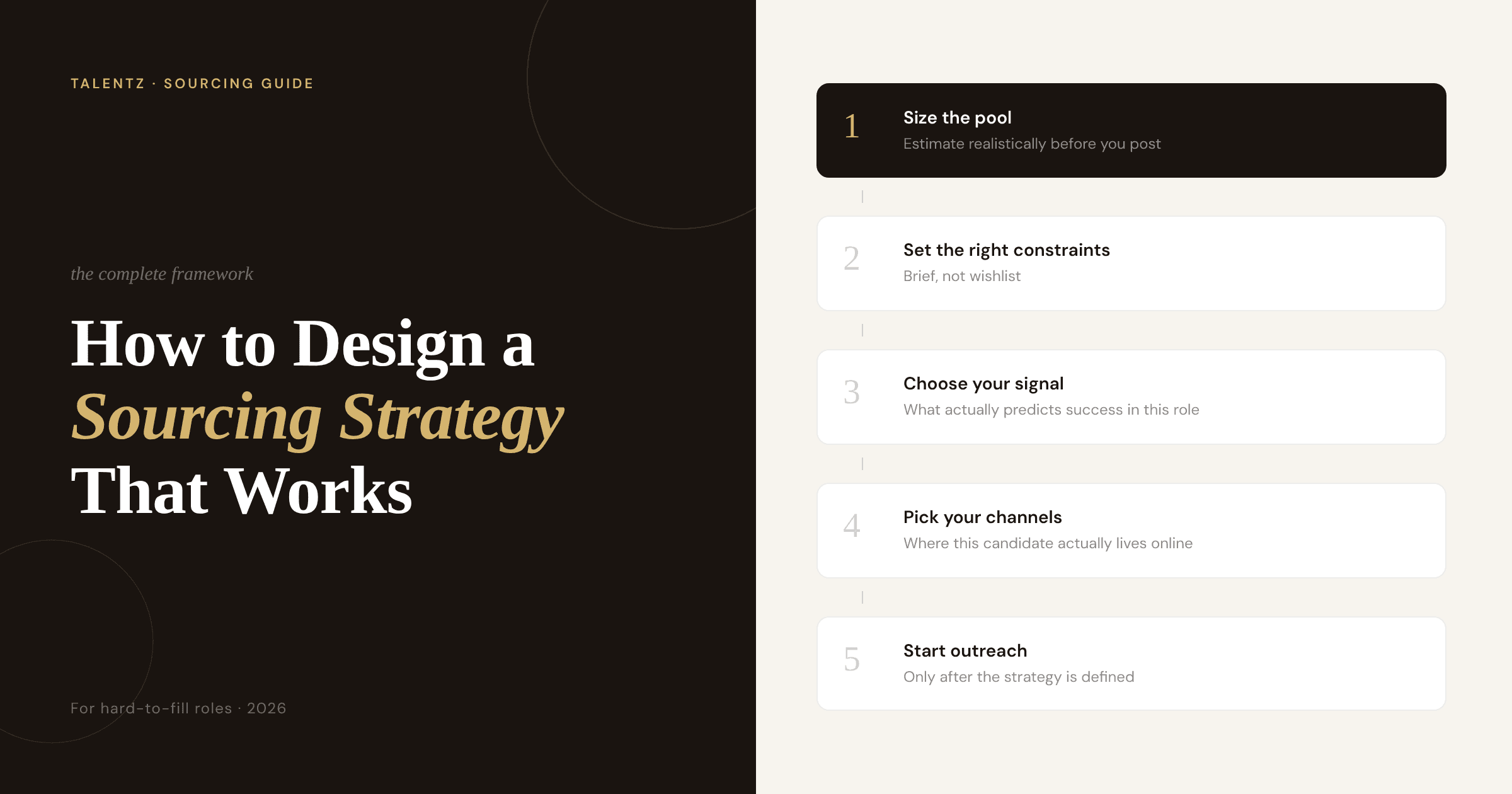
- A sourcing strategy answers three questions: who exactly are you looking for, how many of those people exist, and where will you find them.
- Sizing the pool before the search tells you which kind of problem you have: too many candidates, too few, or a brief that needs to change.
- When results are thin, adjust the brief or the boundary first. Adding more outreach volume to a small pool produces more noise, not more candidates.
- The sourcing strategy should be written before the job description is published, not after two weeks of disappointing results.
What is a sourcing strategy?
A sourcing strategy is the plan you build before the first message goes out. It defines who you are looking for, where those people are, how many of them exist, and in what order you will reach them.
Most teams skip it. They post the job description, open a sourcing tool, type in a title and start sending. That approach works when the role is common and the pool is large. It fails quietly when the pool is small, because nobody identifies the constraint until the search is already two weeks old.
Why hard-to-fill roles need a different approach
Hard-to-fill roles are defined by one of three problems. The skill combination is rare. The location or remote setup narrows the pool. Or the brief was written in a way that eliminates most of the people who could actually do the job.
The first two are real constraints. The third is fixable before the search starts. A sourcing strategy forces you to tell the difference.
Step 1: Define what success looks like in 12 months
Most job descriptions describe the ideal candidate. A sourcing strategy starts from the other end: what does this person need to have achieved in 12 months for the hire to be considered a success?
This distinction matters because the evidence profile follows from the outcome, not from the title or the experience list.
What to write down
- The two or three outcomes the hire must deliver in the first year
- The decisions they will own versus the ones they will advise on
- The team they will work with and what those people already know how to do
- The constraints they will operate under: budget, tech stack, company stage
This exercise often reveals that the role brief includes requirements that are not actually required. Getting this right before the search starts changes the shape of the pool.
Step 2: Write the evidence profile
An evidence profile describes what the person must have already done in order to deliver the outcomes from Step 1. It is different from a list of requirements because it asks for proof, not credentials.
Evidence profile vs requirements list
- Requirements list: 7 to 10 years of backend engineering experience, proficient in Go and distributed systems, experience leading a team of 5 or more
- Evidence profile: Has owned the backend of a product at production scale, made architectural decisions the team still runs on, and brought at least one engineer from junior to independent
The requirements list produces a narrow keyword search. The evidence profile produces a wider search with better filters.
How to build it
For each outcome from Step 1, ask: what does someone need to have done before this role to achieve that outcome? Write the answer as a past action, not a present attribute. "Built and scaled" rather than "experience with scaling."
Aim for three to five evidence criteria. More than five usually means the brief is trying to describe two roles.
Step 3: Size the pool
Before you open a sourcing tool or write a single message, estimate how many people actually match the role.
How to size the pool in 10 minutes
- Take the must-haves from the evidence profile
- Apply them as filters in a sourcing tool or LinkedIn search
- Note the number after each filter you add
- Watch where the number drops sharply. That is your constraint.
What the number tells you
- Large pool (thousands): Filtering problem. The criteria need sharpening.
- Medium pool (hundreds): Workable. Set a shortlist target and choose sources.
- Small pool (under 100): Supply problem. The boundary needs widening or the brief needs adjusting.
- Near zero: The role as written does not exist in the market. The brief needs to change before the search starts.
Step 4: Choose your sources in order
Once you know the pool size, map your sources to match it.
- Direct sourcing: LinkedIn, GitHub, portfolios, conference speaker lists. Best for technical roles where work is public.
- Referral networks: Your team, investors, existing candidates. Best for senior roles where the pool is small and trust matters.
- Community sourcing: Niche Slack groups, newsletters, specific job boards. Best when candidates self-select into communities around their craft.
- Passive inbound: A well-written job post. Fastest when the pool is large and the role is searchable.
- Agency or search firm: Best when the role is senior, urgent and outside your existing network.
Start with the source most likely to find the evidence profile you wrote. Only add a second source if the first does not produce a shortlist in the first week.
Step 5: Set a decision rule for thin results
Before the search starts, write down what you will do if results are thin after the first week.
The adjustments that actually help
- Widen geography. Remote changes pool size more than almost any other lever.
- Expand adjacent titles. A senior backend engineer and a staff software engineer are often the same person at a different company.
- Shift seniority. Ask what a strong mid-level candidate would need to know to do this job well.
- Check the must-haves. At least one is usually a nice-to-have in disguise.
- Change the channel. If LinkedIn is thin, the candidates may live on GitHub or in a specific community.
What not to do
Do not send more messages to the same small list. Do not lower the bar on the evidence profile without revisiting the role outcomes.
How to measure whether the sourcing strategy is working
- Pool to shortlist ratio: what share of people in the pool make it to the shortlist
- Shortlist to interview rate: what share of shortlisted candidates accept an interview
- Interview to offer rate: what share of interviews produce an offer
- Time to first qualified reply: how long from the first message to a positive response from someone who actually fits
If any of these are off in the first week, revisit the strategy before continuing.
Sourcing by role type
Technical roles
Start from public work: GitHub, open-source projects, technical writing, talks. The evidence profile should reference what they have shipped, not what technologies they list. Pool size for specific stacks in specific geographies can be very small. Check it before the search starts.
Executive and leadership roles
Start with referrals from investors and existing network. A VP of Engineering title appears on thousands of profiles. A VP who has scaled through the specific stage your company is entering is a much smaller group.
GTM and commercial roles
Focus the evidence profile on outcomes: pipeline built, revenue owned, deals closed. Source from companies at a similar stage, not from the largest names.
How Zee Scout fits into the process
Zee Scout reads the role brief and evidence profile, sizes the market, and returns candidates ranked by how closely their actual work matches the evidence criteria, not by keyword match.
When results come back thin, Zee surfaces the constraint before outreach starts so the team can adjust the brief rather than spending two weeks finding out the pool was too small.
See also: AI Candidate Sourcing for Hard-to-Fill Technical Roles
Frequently asked questions
What is a sourcing strategy in recruiting?
A sourcing strategy is the plan built before the first message goes out. It defines who the role is for, how many of those people exist, and where and in what order to find them.
What is the first step in building a sourcing strategy?
Define what success looks like in 12 months, then build an evidence profile describing what the person must have already done to achieve those outcomes. This comes before the job description.
How do you source candidates for hard-to-fill roles?
Size the pool first. If it is small, identify the constraint before starting outreach. Prioritize referrals and direct sourcing from public work. Adjust the brief, not the volume, when results are thin.
Why is my sourcing producing thin results?
Usually because a constraint in the brief, a seniority requirement, a location, or a combination of must-haves, dramatically narrows the pool. Check the pool size with real constraints applied before concluding the talent does not exist.
When should you use a recruiting agency?
When the role is senior, urgent and outside your existing referral network, and when direct outreach will not produce results in the time available.
How do you source passive candidates?
Directly, from places where their work is public: GitHub, portfolios, conference speaker lists, niche newsletters. The message must reference their specific work. Passive candidates receive a lot of generic outreach. A message that shows you looked at what they built is significantly more likely to get a reply.