Key takeaways
- A recruiting sequence is not a conversation. A conversation-aware workflow is.
- There are five types of candidate reply, and each one needs a different next step.
- Timing follow-ups on a fixed schedule after a reply tells candidates that nobody read what they wrote.
- Context should travel with the candidate across every channel and every step.
- Handoffs to recruiters are a core part of the workflow, not a failure mode.
What is conversation-aware recruiting?
Conversation-aware recruiting is an approach to candidate outreach in which the system reads what a candidate says and uses it to decide what should happen next, rather than following a fixed sequence of messages on a preset schedule.
In a standard outreach sequence, the workflow is determined in advance: a first message, a follow-up after a few days, a second follow-up after a few more. The sequence runs the same way for every candidate, regardless of whether they replied, what they said, or which channel they used.
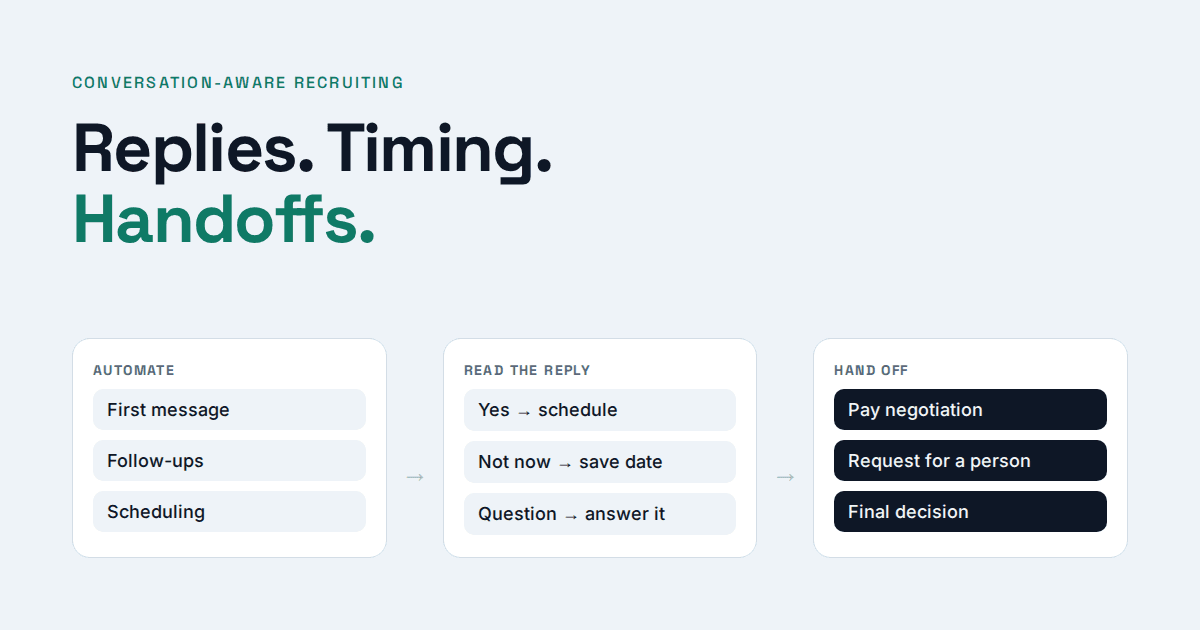
In a conversation-aware workflow, what happens next is determined by the candidate's reply. A yes leads to scheduling. A not now leads to a timed follow-up. A question gets answered. A no stops all future contact.
The difference is not about the technology. It is about whether the workflow is designed around what candidates say or what the tool can send.
Why sequences break after the first reply
Most recruiting outreach processes are built for the first touch. The sequence is designed, the copy is reviewed, the timing is set, and the tool sends.
The moment a candidate replies, the sequence becomes a liability.
A candidate says the timing is not right. The next scheduled message goes out anyway.
A candidate asks about the salary range. The follow-up thanks them for their time and asks if they had a chance to review the role.
A candidate says they are not the right person but names a colleague who might be. The workflow has no way to capture that information.
None of these are technical failures. The messages delivered. The sequence ran as intended. The problem is that the sequence was not designed to account for what a candidate might say.
A conversation-aware workflow is designed around that problem from the start.
The five reply types and what should happen next
Most candidate replies fall into five categories. Each one calls for a different next step.
1. Yes, interested
The candidate is interested and ready to move forward.
What should happen: Move to scheduling. The next step should not be another message asking if they are still interested. The context from the conversation, including why they were contacted and what they said, should travel into the scheduling step.
What often happens instead: A follow-up thanks them for their interest and asks them to click a link to book a time. No human sees the reply until a meeting is booked.
2. Not now, but open to reconnecting
The candidate is interested but the timing is wrong. They mention a bonus, a vesting date, a project ending, or simply say they are not ready to make a move right now.
What should happen: Acknowledge the reply, agree on a time to reconnect, and make it easy for them to opt out if they change their mind. Capture the reason and the follow-up date. When the time comes to reconnect, the first message should pick up where the last conversation ended, not start over.
What often happens instead: The sequence keeps going, or it stops and the candidate is never contacted again.
3. A question about the role, the company, or pay
The candidate is engaging but wants more information before deciding whether to continue.
What should happen: Answer the question, or escalate to a recruiter who can. The next message in the sequence should not go out until the question has been addressed.
What often happens instead: The next scheduled template goes out as if the question was never asked. The candidate receives two messages at once: an automated follow-up and no answer to what they asked.
4. Wrong person, possible referral
The candidate is not relevant for the role, but they may know someone who is.
What should happen: Thank them, note whether they suggested someone, and stop all further contact. If a referral was given, capture it in a way that the team can act on it.
What often happens instead: The sequence continues. The candidate receives a follow-up after saying they are not the right person.
5. No response
The candidate has not replied to the first message.
What should happen: One or two follow-ups spaced several days apart, each adding something new rather than repeating the original message. After that, stop.
What often happens instead: Three to five follow-ups on a fixed schedule, each with increasingly informal language designed to seem personal, until the candidate unsubscribes.
Timing: when to follow up, and when to stop
The timing of a follow-up should be driven by the candidate's situation, not by the tool's schedule.
For a candidate who said not now, the follow-up should arrive when they said to reconnect, not before. If they said the timing would be better in spring, a follow-up in January is not the right move.
For a candidate who has not replied, spacing matters. A second message the next day signals that the first was automated. A message four or five days later gives the candidate time and signals that the outreach is considered.
For a candidate who has asked a question, the follow-up should come after the question is answered, not in parallel with it.
When to stop
Stopping is as important as following up. A workflow that does not stop loses the trust of candidates who have already signaled that they are not interested.
Stop after:
- An explicit no
- An unsubscribe or opt-out
- Three touches with no reply
- A reply that places the candidate outside the target criteria for this role
Keeping context across channels
Candidates reply wherever it is easiest for them. A message arrives by email and the reply comes by text. A WhatsApp message prompts a voicemail. A LinkedIn note leads to an email.
For a recruiter, this creates a fragmented picture. Each channel holds part of the conversation, and none of them holds all of it.
A conversation-aware workflow maintains one record per candidate, regardless of which channel they use. When a recruiter picks up the conversation, they see everything: what was sent, what the candidate said, which channels were used and what the agreed next step was.
Why this matters for the follow-up
A follow-up that ignores what a candidate said in a previous message tells them the outreach is not real. If a candidate mentioned they are waiting on a bonus and the next message asks if they had a chance to review the role, the conversation is over.
Context should not need to be re-entered. It should travel with the candidate from the first message to the last.
Handoffs: when and how to pass to a recruiter
Some conversations should not be handled by software alone.
A recruiter should take over when. For a wider look at which hiring tasks should stay human, see our AI candidate screening guide. Explore all Zee agents and how they fit the full loop:
- The candidate has questions about pay that need negotiation or judgment
- The candidate is expressing hesitation that is not covered by a standard reply
- The candidate has asked to speak with a person
- The reply does not fit any known category and the system is not confident in the next step
- The role is senior or high-stakes and the conversation has reached a decision point
The handoff should not feel like a restart. When a recruiter takes over, they should receive the full conversation: what was sent, what the candidate said, the reason for the handoff, and the agreed next step if one exists.
A recruiter who starts from scratch after a candidate has already engaged with the outreach wastes the candidate's time and signals that the team is not organized. See also: Zee Lens for how structured evaluation picks up with the full context intact.
How to build a handoff that works
- Pass the full conversation history, not just the most recent message
- Include the reason for the handoff in plain language
- Note any commitment the outreach made, such as a follow-up date or an answer promised
- Give the recruiter a suggested opening that picks up from where the conversation ended
A setup checklist for conversation-aware outreach
- Write the reply rules before the first message goes out. Decide what should happen in each of the five reply states before any candidate receives a message.
- Remove channel silos. Make sure replies from every channel appear in one place, in order.
- Set a stop rule. Define how many touches with no reply before the outreach ends, and enforce it.
- Make handoffs a planned step. Define the conditions that trigger a handoff to a recruiter and what information travels with it.
- Test the edge cases. Before going live, check what happens if a candidate replies with a question, says not now, or asks to speak with a person.
- Review recent replies monthly. Look at the last twenty candidate replies and check what happened next. That is where the gaps will be.
How to measure whether it is working
- Positive reply rate: what share of replies express interest or ask a qualifying question
- Sequence exit reason: how often does the outreach stop because of a reply versus running to completion with no engagement
- Context retention: when a recruiter takes over, do they need to ask for information the candidate already gave
- Re-contact complaints: how often do candidates report being contacted after opting out or saying no
- Conversation-to-interview rate: what share of replied conversations lead to an interview
How Zee approaches conversation-aware outreach
Zee Engage keeps one conversation per candidate across email, text, WhatsApp and voice. It reads each reply and decides the next step based on what the candidate said. When the conversation needs a person, it passes everything to a recruiter, including the full history and the reason for the handoff.
The hiring manager makes the hire decision. Zee handles the conversation until it is time for a person to take over.
Frequently asked questions
What is conversation-aware recruiting?
Conversation-aware recruiting is an approach to outreach in which the workflow adapts to what a candidate says, rather than following a fixed sequence. Each reply type, such as yes, not now, or a question, triggers a different next step.
How should AI handle a candidate who says not now?
Acknowledge the reply, capture the reason and the agreed follow-up date, stop the sequence, and reconnect at the right time with a message that continues from where the last conversation ended. Do not send another follow-up before that date.
How many follow-ups should a recruiting sequence include?
For candidates who have not replied, two to three follow-ups spaced several days apart is a reasonable limit. Each should add new information rather than repeating the original message. After that, stop. For candidates who have replied, the number and timing of follow-ups should be based on what they said, not on a preset schedule.
How should context travel across channels in recruiting?
One record per candidate, updated with every message and reply regardless of channel, and visible to everyone who might pick up the conversation. A recruiter should never need to ask a candidate to repeat something they already said.
When should a recruiter take over from an AI in recruiting?
When the conversation involves pay negotiation, expressed hesitation, a request to speak with a person, or any reply the system cannot confidently categorize. The handoff should include the full conversation history and the reason for the escalation.
Does conversation-aware outreach require AI?
No. The principles apply to any outreach process. AI makes it easier to run conversation-aware outreach at scale, particularly when candidates reply across multiple channels, but a small team can apply the same logic manually.
Sources
- AI in hiring and evaluating workers: what Americans think, Pew Research Center, April 2023
- Gartner survey shows just 26% of job applicants trust AI will fairly evaluate them, Gartner, July 2025
This article is general information, not legal advice.