Key takeaways
- Personalized wording and contextual next-action logic are two different things. Most outreach tools only do the first.
- A message that uses a candidate's name and job title is not the same as a message that responds to what a candidate actually said.
- AI should automate the work of deciding what happens next, not just format the first message.
- Good outreach is judged by what happens after the reply, not by the quality of the first send.
- The handoff to a recruiter is a feature, not a fallback.
What is AI candidate outreach?
AI candidate outreach is the use of software to find, contact and follow up with candidates on behalf of a hiring team. It can cover the first message, follow-ups across multiple channels, answers to candidate questions, scheduling and conversation handoffs.
In practice, most tools focus on automating the first message. The harder, more valuable problem is what happens after a candidate replies.
The difference between personalization and automation
These two words are often used together, but they describe different things.
Personalization is about the words in a message. It means referencing something specific about the candidate: a project they worked on, a role they held, or a reason why the opportunity is relevant to them. Done well, it makes a message feel written for one person.
Automation is about the decisions a system makes. Which candidates to contact. When to follow up. What to say when a candidate replies with a question. When to stop. When to hand the conversation to a recruiter.
A fully personalized message can still be part of a rigid, automated sequence that ignores everything the candidate says next. And a lightly personalized message can sit inside a workflow that adapts to every reply.
The two are independent. The mistake most teams make is investing heavily in the words and very little in the decisions.
Why the first message is not the hard part
Most recruiting outreach gets reviewed at one point in the process: before the first message goes out.
Copy is reviewed. Subject lines are tested. Timing is optimized. Send rates are tracked.
By the time a candidate replies, the attention has usually moved on.
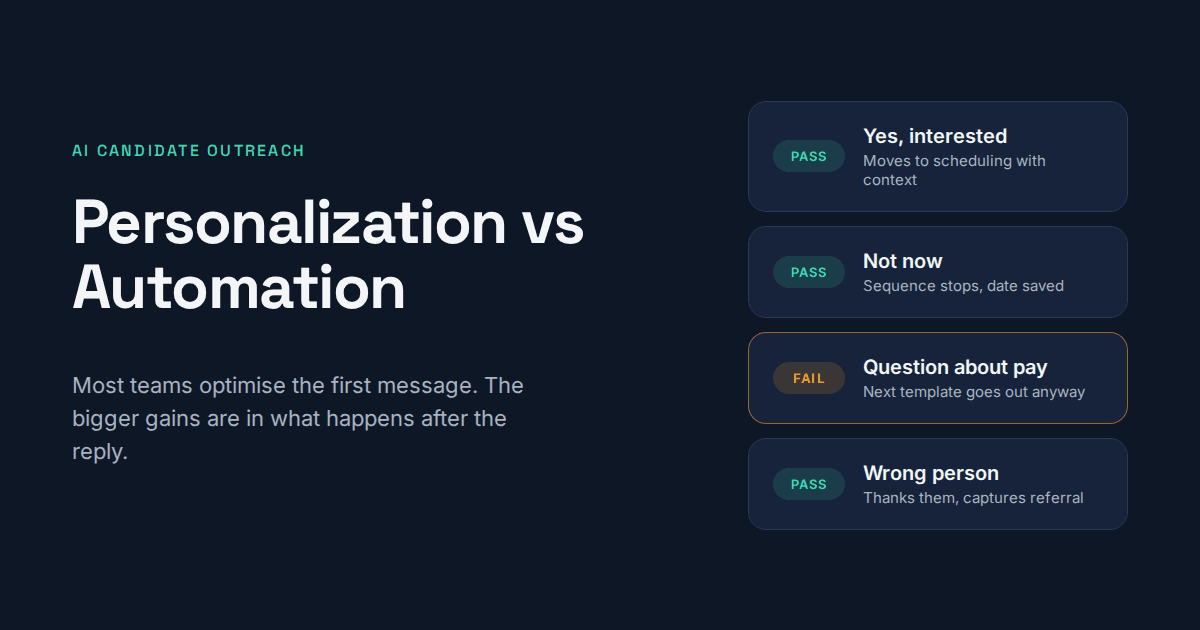
This is where most processes quietly break. A candidate says they are interested but the timing is wrong. The sequence keeps going. A candidate asks about the salary range. They receive the next scheduled template. A candidate says they are not the right person but forwards the message to a colleague. The workflow has no way to capture that.
None of these failures show up on a dashboard. Every message was delivered. Every open was counted.
But the conversation had already ended.
What personalization can and cannot fix
Personalization in the first message can improve reply rates. Using a candidate's real work, mentioning a specific project or explaining why the role is relevant to them makes a message worth reading.
But personalization in the first message cannot fix what happens after the reply. That requires a different kind of logic: one that reads what the candidate said and decides what should happen next.
This is the gap between personalized outreach and intelligent outreach. For the next step in building a smarter outreach workflow, see our guide to [conversation-aware recruiting](/blog/conversation-aware-recruiting).
What AI should personalize
Personalization is most effective when it is specific, job-relevant and verifiable.
What to personalize:
- The reason for reaching out. Reference a piece of work, a contribution or a skill that is directly relevant to the role.
- The role itself. Explain what the company is building and why it is relevant to this candidate right now.
- The timing. If the candidate recently changed roles, shipped something visible or posted about a topic relevant to the role, that is a reason to reach out.
What not to personalize:
- Generic compliments. Saying a candidate has an impressive background is filler, not personalization.
- Details that could apply to anyone. If the sentence works equally well for ten other candidates, it is not personalized.
- Inferences from limited data. If you do not have a clear, relevant reason to reach out, do not invent one.
What AI should decide
The decision layer is where most outreach tools leave teams on their own.
Reply states and what should happen next:
- Yes, interested: move to scheduling. Carry the full context, including what the candidate said and why they were contacted, into the next step.
- Not now, but open to reconnecting: stop the sequence, capture the reason and the follow-up date, and reconnect at the right time with a message that picks up where the last one ended.
- A question about the role or pay: answer it, or hand it to a recruiter. Do not let the next template go out as if the question was never asked.
- Wrong person, here is a referral: thank them, capture the referral if one was given, and stop.
- No response: one or two spaced follow-ups that add new information, then stop.
- An explicit no: acknowledge it, stop all follow-ups and do not contact again.
Each of these requires a different next action. A system that sends the same follow-up regardless of what the candidate said is not automating outreach. It is automating the wrong thing.
The handoff to a recruiter
Not every reply should be handled by software.
Some conversations need a person. Pay negotiation, specific questions about the team or culture, a candidate who seems interested but hesitant, or any situation where a reply does not fit a clear category.
The handoff to a recruiter should be treated as a core feature of the outreach workflow. For a full framework on where humans stay in control across recruiting, see our guide to human-in-the-loop AI recruiting. Talentz is built around this same principle — see how it works, not as a failure mode. When a system escalates a conversation, it should pass everything it knows: the candidate's reply, the history of the conversation, and the reason for the escalation.
A recruiter who picks up a conversation mid-way should not have to start over.
How to decide when to escalate
A few signals that a conversation should go to a person:
- The candidate has asked about compensation more than once
- The candidate expresses hesitation that is not covered by a standard follow-up
- The candidate asks to speak with someone
- The system cannot place the reply into a known category with reasonable confidence
- The candidate is very senior or the role is especially high-stakes
Common mistakes in AI candidate outreach
Stopping at the first message. Most optimization effort goes into what gets sent before anyone replies. The bigger gains are in what happens after.
Personalization that is not relevant. Mentioning a candidate's employer or title is not the same as giving them a reason to consider the role. Personalization earns attention; relevance earns a reply.
Sequences that ignore replies. A follow-up that goes out after a candidate has already said not now tells the candidate that nobody read what they wrote.
Measuring sends and opens, not conversations. Outreach is working when it produces qualified conversations, not when it produces email opens. The metrics should follow the goal.
Treating every reply the same. A yes, a not now, a question and a referral all need different next steps. A workflow that handles all of them the same way is treating candidates as entries in a list, not people in a conversation.
How to measure outreach quality
Move beyond open rates and reply rates as the primary measure of success. If you are also evaluating how AI fits into the broader screening process, our guide to AI candidate screening. You can also see how Zee Scout surfaces candidates before outreach even begins. See also: Zee Engage | Pricingidate-screening) covers the full automation boundary.
- Positive reply rate: what share of replies express interest or ask a qualifying question, as opposed to unsubscribes or misdirected messages
- Qualified conversations started: how many replies led to a next step in the hiring process
- Sequence exit rate by reason: how often did the workflow stop because a candidate opted out, said not now, or was referred on, versus how often it ran to completion without any reply
- Recruiter takeover rate: how often did a recruiter need to take over a conversation, and at which point
- Follow-up relevance: when a follow-up was sent after a reply, did it reflect what the candidate had said
How Zee handles candidate outreach
Zee Engage runs two-way conversations with candidates across email, text, WhatsApp and voice, keeping one thread per person regardless of which channel they reply on. It reads what candidates say and decides the next step based on that, not on a fixed schedule.
When a candidate needs to speak with a person, Zee hands the conversation to a recruiter with the full context attached. The hiring manager makes the final hiring decision.
Frequently asked questions
What is AI candidate outreach?
AI candidate outreach is the use of software to contact candidates, follow up and manage conversations on behalf of a hiring team, covering initial messages, replies, scheduling and handoffs.
What is the difference between personalization and automation in recruiting outreach?
Personalization is about the words in a message, specifically how relevant and specific they are to one candidate. Automation is about the decisions the system makes: who to contact, when to follow up, what to do when a candidate replies. The two are independent, and most tools invest much more in the first than the second.
Does AI outreach actually work?
It depends on what it is optimizing for. AI outreach that focuses only on the first message can improve reply rates. AI outreach that also handles replies intelligently, by adapting the next step to what the candidate said, produces better conversations and wastes less of the candidate's and recruiter's time.
Should AI send follow-ups after a candidate replies?
Only if the follow-up reflects what the candidate said. See our guide to [AI candidate outreach](/blog/ai-candidate-outreach-personalization-vs-automation) for how to separate personalization from next-action logic. A follow-up that goes out on a fixed schedule after a reply, without taking the reply into account, is a signal to the candidate that the outreach is not real. If a candidate has replied, the next message should respond to what they wrote.
When should AI hand a conversation to a recruiter?
When the reply needs judgment that a system should not make alone: pay negotiation, expressed hesitation, a request to speak with someone, or anything outside a known reply category. The handoff should include the full conversation history.
Is AI candidate outreach legal?
In most cases yes, but applicable laws vary. Some jurisdictions regulate automated messaging, opt-out requirements and data retention. Tell candidates when they are speaking with an AI-assisted process, and honor opt-outs immediately.
Sources
- Recruiters see job applications triple to more than 300 per role, HR Dive, May 2026
- Gartner survey shows just 26% of job applicants trust AI will fairly evaluate them, Gartner, July 2025
This article is general information. Laws on automated candidate messaging vary by jurisdiction.